How Much Does a Water Softener Cost?
Hard water has become a common issue as many people encounter dry skin and hair after using water and notice scale building up in the pipes. The only solution for this issue is buying a water softener system. But how much does it cost and is it really worth the money? Don’t worry because we will help you discover the right answer!
We have discussed the cost of water softener in detail and jotted down everything you need to know about its pricing. From the factors that influence its cost to its benefits and installation techniques, you will discover how everything adds up to the final investment and if you should install one or not. So, let’s look at the comprehensive guide below!
How Much Does a Water Softener Cost?
In Canada, a water softener costs from $600 to $5,000+, depending on the system type, manufacturer, water hardness level, and household size.
The table below breaks down the prices of water softeners with installation across Canada.
| System Type | Typical Cost Range | Best For | What’s Included |
| Basic System (Small Home) | $600 – $1,500 | 1–2 person households, lower hardness levels (3–10 gpg) | Single-tank unit, basic bypass valve, standard installation |
| Standard / Mid-Range System | $1,500 – $3,000 | 3–4 person households, moderate hardness (10–20 gpg) | Metered regeneration, higher resin capacity, 5–10 year warranty |
| Premium / High-Capacity System | $3,000 – $5,000+ | 5+ person households, very hard water (20–50+ gpg) | Dual-tank design, high-efficiency metered regeneration, advanced control valve |
| Water Softener + RO System | $3,500 – $7,000+ | Homes wanting both softened water throughout and purified drinking water at the tap | Softener for whole house + dedicated under-sink RO system for kitchen |
* All figures include professional installation but exclude annual maintenance.
Various factors influence the final water softener price. Large and busy households demand high-capacity systems, which have a higher upfront cost, but save money on salt and water consumption over time.
The cost of installing a water softener by a certified professional ranges between $300 and $800, depending on your house’s plumbing layout. Ongoing system maintenance, including annual cleaning and salt refills, falls between $50 and $150 annually.
How Much is a Water Softener: Cost Breakdown by Type
In Canada, the water softener cost + installation varies significantly by technology. Salt-based ion exchange systems typically cost $1,000–$3,500, while salt-free conditioners are often $1,500–$5,000+. Magnetic descaling units are the most economical at $150–$500. A whole-home softener paired with an under-sink reverse osmosis (RO) system can range from $3,500 to $7,000+.
The table below breaks down average installed costs across Canada for each type
| Water Softener Type | Average Cost of Water Softeners Installed (CAD) | Best For | Key Trade-offs |
| Salt-Based Ion Exchange (Single tank) | $1,000–$3,500 | Canadian homes with moderate to very hard water (10–50+ gpg) | Very effective; adds sodium to water; requires salt refills ($8–$15/month) |
| Dual-Tank Ion Exchange | $2,000–$5,000+ | Large households with a continuous demand for water | Never runs out of soft water; higher upfront cost; larger environmental footprint |
| Salt-Free Conditioner | $350–$5,000+ | Eco-conscious homeowners seeking scale prevention without using sodium or producing wastewater | No salt or chemicals; conditions the water, doesn’t soften; higher upfront cost |
| Magnetic & Electronic Descalers | $150–$500 | Budget-conscious homeowners with mild scaling issues | Low cost; easy DIY install; mixed effectiveness; not a true softener |
| Water Softener + RO System | $3,500–$7,000+ | Homes needing both whole-home soft water and purified drinking water | Complete solution; highest upfront cost; two separate systems |
Salt-Based Ion Exchange Softener
Salt-based ion exchange softeners cost between $500 and $2,500. Factor in the water softener installation price, and the unit will cost $1,000-$3,500.
A salt-based ion exchange softener, also known as a water conditioner, cation exchange system, or ion exchange unit, is the most common and popular type of water softener among Canadian homeowners.
It works by pushing water through a resin tank containing negatively charged beads. The beads attract the calcium (Ca²⁺) and magnesium (Mg²⁺) ions (hardness minerals), and swap them for sodium (Na+) ions from a salt brine solution stored in the brine tank.
The result? Soft, refreshing water that tastes great, forms a rich and foamy lather, results in brighter laundry, leaves your hair and skin feeling clean and light, and keeps your pipes safe against scale.
There are a few trade-offs, though. Your monthly expense on salt will be around $8-$15. These systems have a regeneration cycle that flushes the accumulated hardness minerals. Typically, the salt-based water softeners produce around 20 to 70 gallons (75 to 265 liters) of wastewater per cycle, which usually happens 1 to 2 times every week.
Nonetheless, salt-based ion exchange softeners are an effective solution to treat moderately to very hard water.
Dual-Tank Softener
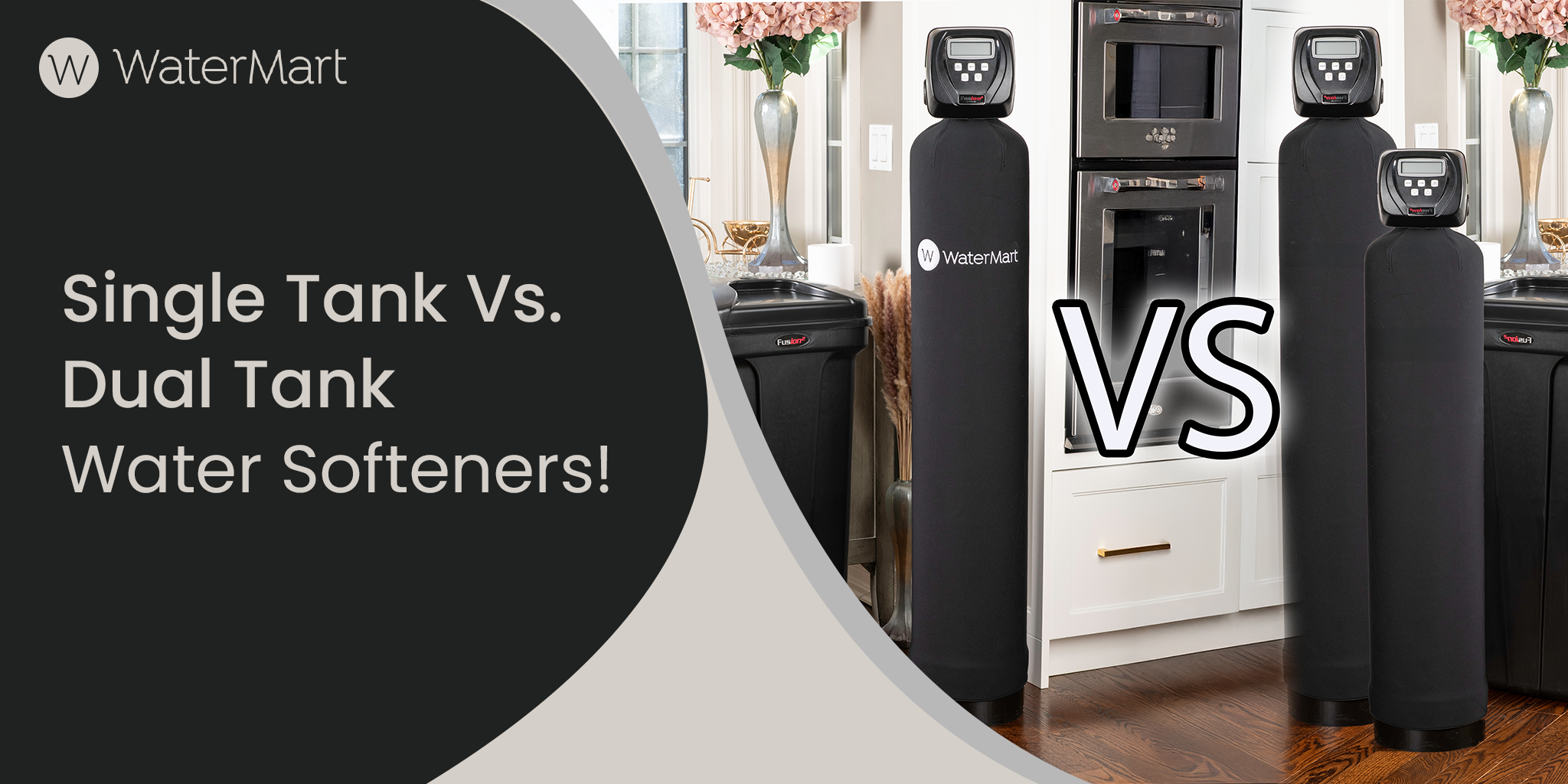
In Canada, the cost of a new water softener with a dual tank is around $2,000-$5,000 with installation. The unit itself costs around $1,500-$4,000. Higher-end models by premium brands, or those that combine chlorine removal with softening, cost $4,000-$8,000.
A dual-tank system consists of two resin tanks: one softens water while the other recharges as opposed to a single tank unit that pauses to regenerate soft water. The benefits? You get an endless supply of water without any interruption, ideal for shared spaces, hostels, guesthouses, and large households.
The trade-offs? The upfront cost is towards the higher end, and the system demands more floor space.
Salt-Free Conditioner
In Canada, the price of a whole-house salt-free water conditioner ranges from $350-$5,000+, depending on the technology, brand, and whether you get professional installation. Entry-level units cost around $350-$800, mid-range media systems (that require cutting your main water line) at $500-$2,500 with installation charges around $200-$600, and premium whole-home units with additional filtration stages and professional installation cost $2,500-$5,000+.
The wide spectrum reflects the difference between basic scale-prevention units and high-capacity systems engineered for very hard water.
Salt-free water conditioners don’t remove the hardness minerals. Instead, they use the template-assisted crystallization (TAC) process to alter the structure of calcium and magnesium ions. Once their structure changes, they cannot form limescale. These minerals stay in the water but don’t adhere to surfaces, pipes, fixtures, and appliances and later rinse away.
The best thing about these systems? They need no salt, chemicals, or electricity. And they don’t even produce any wastewater, making them perfect for eco-conscious homeowners.
The only trade-off: they don’t really soften water, so the soap efficiency doesn’t improve as it does with a salt-based softener.
Magnetic and Electronic Descalers
Electronic and magnetic descalers are the most affordable water softening solutions, costing between $150 and $500.
These devices wrap around your main water line, creating a magnetic or electromagnetic field. This field changes the charge of hardness minerals so they repel each other and the pipes, which prevents scale formation.
They are simple to install: just clamp the device on the pipe and plug it in. That said, they are not effective at handling hard water and are suitable for homeowners with mild scaling problems seeking a low-cost, no-maintenance solution.
Water Softener with Reverse Osmosis
Pair a whole-house water softener with an under-sink reverse osmosis (RO) unit, and you get a brilliant water treatment solution, which costs around $3,500-$7,000+, including installation charges.
The water softener in this combo addresses the hardness minerals, shielding your water heaters, appliances, pipes, and fixtures against scale. Meanwhile, the RO system, typically installed at your kitchen sink, uses an RO membrane (0.0001 micron size) to remove up to 99% of impurities, including heavy metals, bacteria, parasites, hardness minerals, nitrates, per- and polyfluoroalkyl substances (PFAS), and total dissolved solids (TDS).
This is the best solution for:
- Homes relying on well water with elevated levels of heavy metals or nitrates
- Health-conscious homeowners
- Families with members struggling with serious health issues or compromised immune systems
- Homeowners seeking complete relief from contaminants in water, including hardness minerals
The only downside of this combo? The higher upfront cost.
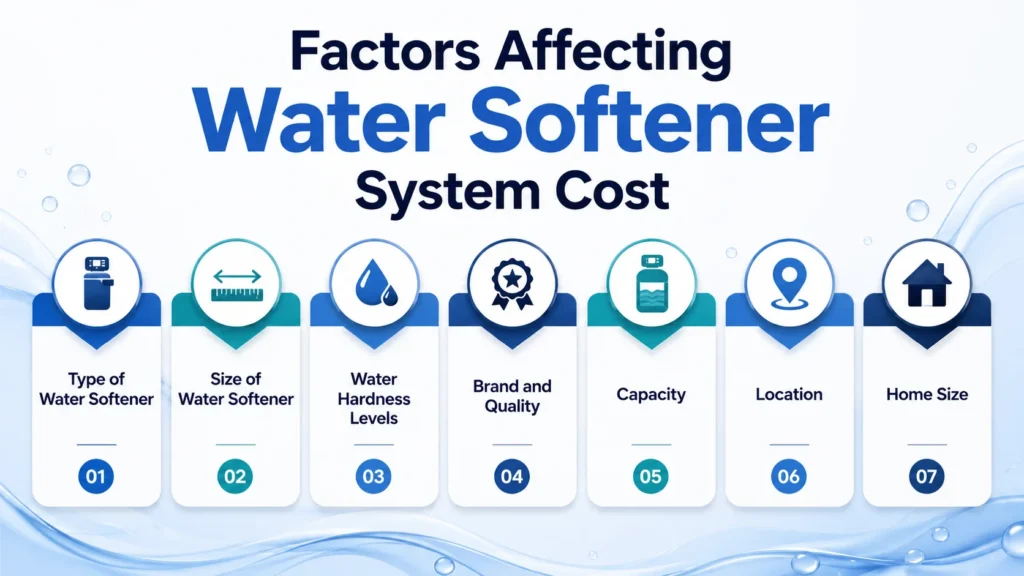
Factors Affecting Water Softener System Cost
Multiple factors contribute to this water softener cost. The price of a water softener system is not fixed and many things like the type of water softener, its size, capacity, and brand alter its pricing.
In this section, we will be looking at a few major factors that can help you choose the most suitable and affordable water softener for yourself.
Type of Water Softener
The type of water softener you buy directly affects your upfront cost because every technology comes with different components, materials, and complexity.
Basic technologies like electronic and magnetic descalers are pocket-friendly but don’t deliver effective results consistently—they rely on unproven electromagnetic fields with no physical media.
Salt-free water conditioners cost more because they use physical media tanks and TAC technology. Premium salt-free conditioners cost even more as they are whole-home systems with supplemental filtration stages and higher flow rates.
Salt-based ion exchange softeners cost more than salt-free conditioners because they include resin tanks, brine tanks, and control valves and require regular salt refills. A dual-tank system costs significantly more than a single-tank unit because it offers continuous soft water with no regeneration downtime, larger resin capacity, and higher-quality control valves.
RO systems cost more as they remove hardness minerals along with nearly all other contaminants. Point-of-use RO systems cost less; whole-home RO systems cost more due to larger membranes, stronger booster pumps, and remineralization stages.
Size of Water Softener
A larger size of water softener means it can soften more hard water. A double-tank ion-exchange water softener is a large-size water softener that takes up much space. It eventually leads to a higher installation and maintenance cost as well.
Water Hardness Levels
Experts measure water hardness levels in different units, but here, we will discuss the hardness according to the grains per gallon. This can be any value between 0 and 20 and if it ever goes above 7, your water is harder than it should be. The higher the hardness level of the water, the greater the water softener capacity required and the higher the price.
If you want to save up water testing money, you can schedule a free water test at WaterMart now! Once you fill out this form, we will get back to you soon for proper testing and will also explain the water test results to you properly.
Brand and Quality
Different brands charge different prices for their water softeners. Famous brands use high-quality materials and advanced technology, so they charge more.
Capacity
The capacity of water softener starts from 24000 grains and goes up to 100,000 grains. This refers to the amount of hard water it can soften until it is replaced or regenerated. The price starts from as low as $500 and reaches up to $2500.
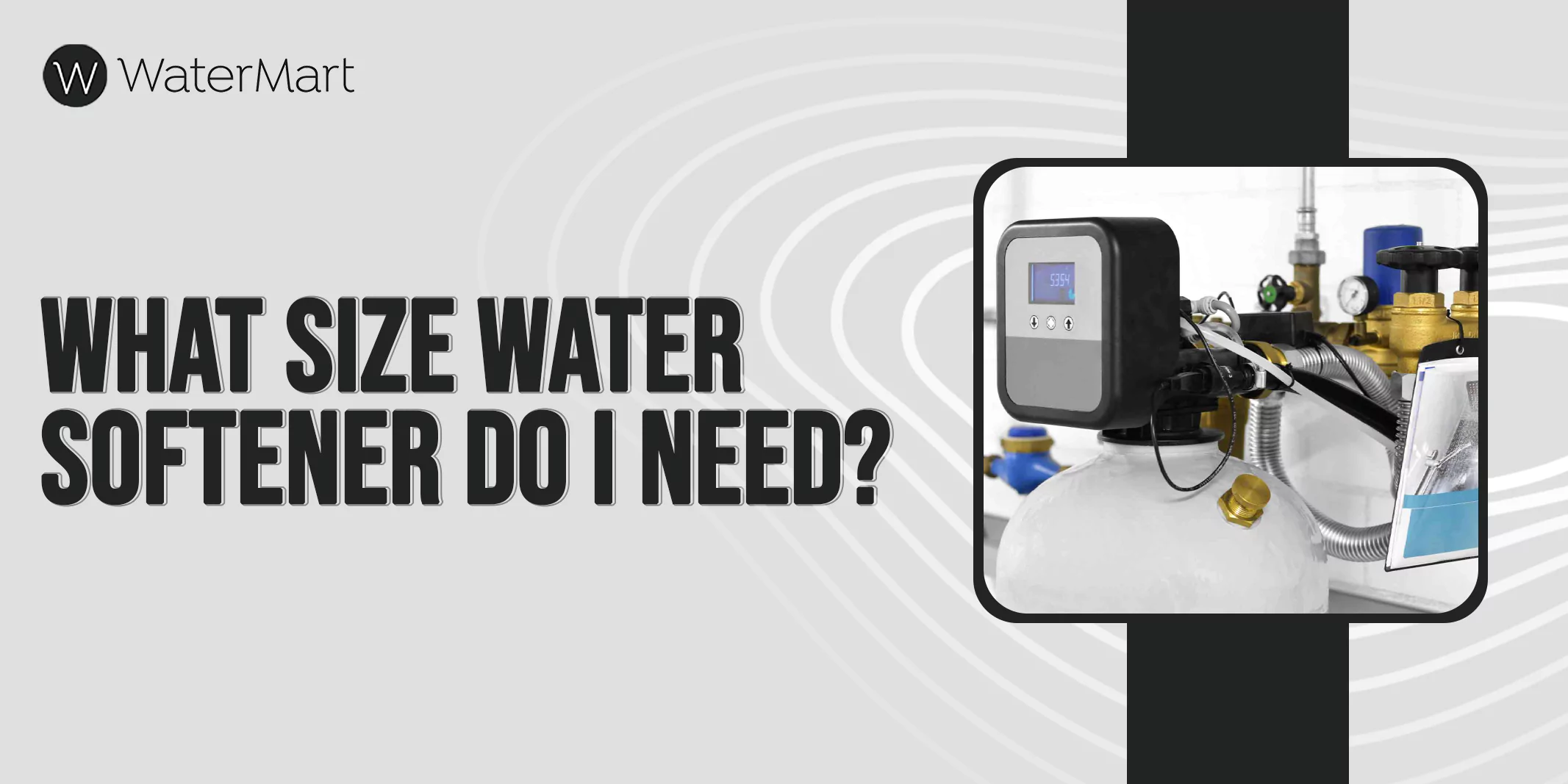
You should find out the capacity required for your household, considering your daily water consumption and the number of family members. It also depends on how much water each person in the house uses. For instance, four members will require a capacity of 24000 grains but if their usage is more than an average human’s, the capacity requirement can increase. By finding this out, it will be easier for you to know what size of water softener you need.
Location
Your house area also decides how hard your water is. You can contact the workers at the water supply plant and inquire about the hardness of your water. Most of the time, water that comes from a well is more hard than any other water provision. If the water supply in your area has a very high hardness level, you will need a greater capacity water softener which ultimately costs more.
Home Size
It does not play a major role in the cost development of water softeners, but if you have a home spread over a larger hectare or height, it means it has more pipes and bathrooms and requires a large supply of water.
Since we have discussed the factors, now it’s time to figure out how you can manage the installment charges.
Do I Need Professional Help Installing A Water Softener?
Installing a water softener is easy, especially if you have purchased a small water softener system like a salt-free system or point-of-use reverse osmosis. All you have to do is use the right tools and follow the proper steps carefully until you fix it in place. However, when it comes to installing large-sized water softeners, you certainly need professional help. It costs between $500 and $1500 to hire an expert.
If you are looking for a reliable water system installation service, we are here to help. At WaterMart, our installation experts are highly skilled, have good-quality equipment, and ensure a hygienic installation by wearing gloves during the process. Contact us now to book an affordable installation.
When to Consider Buying a Water Softener System?
After analyzing the cost of a water softener system, you must ask yourself: Is water softener really a need for you? and can you drink softened water? We know exactly when one should consider installing it in their house or any commercial building. Here is a breakdown of the circumstances when a water softener becomes a necessity:
- A professional water test confirms high levels of calcium and magnesium, with hardness exceeding 7 grains per gallon (GPG). In this case, a water softener is often the most effective solution for protecting your home and appliances.
- You notice white scale buildup on faucets, showerheads, sinks, kettles, or other water-using appliances. These mineral deposits are a strong indication of hard water and can lead to costly maintenance issues over time.
- Your skin feels unusually dry or itchy after bathing, or your hair appears dull, brittle, and difficult to manage. Hard water minerals can leave residue that affects both skin and hair health.
- Soap, shampoo, and detergents produce very little lather, forcing you to use larger amounts of cleaning products to achieve the desired results. Soft water improves cleaning efficiency and reduces product waste.
- You have experienced an increase in water or energy bills due to scale buildup inside pipes, water heaters, and appliances. Mineral deposits reduce efficiency and force systems to work harder.
- Stubborn water spots and stains frequently appear on dishes, countertops, sinks, glass surfaces, and appliances despite regular cleaning. These recurring marks are a common sign of excessive water hardness.
- Your drinking water has developed an unusual taste or odor that may be associated with high mineral content or other water quality concerns. A professional water test can help determine whether treatment is necessary.
Benefits of Installing a Water Softener System
There are many benefits of water softening system. However, water softener systems are best known for removing chemicals like calcium and magnesium from the water. The removal of these chemicals enhances the quality of the water making it fresher and softer to use. A few benefits that these systems offer for their price are:
Softer Skin and Hair
Tired of having dried and damaged hair and skin? Don’t worry because, with the installation of a water softener, this is not an area of worry anymore. Softened water will make your skin and hair feel softer after bathing. It will also increase the volume of your hair and make it healthier.
Efficient Use of Cleaning Products
Secondly, you will not face any wastage of cleaning products because, with softer water, they form a good lather when used even in small quantities. Soaps will also not leave scum (white layer) on the soap dishes or sinks.
Less Scale Buildup
The best part is that there will be no scale build-up in the water pipes. This will prevent clogging in the pipes and also reduce water bills.
Better-Tasting Water
Additionally, you will have a consistent supply of softer water that tastes better, smells nicer, and is healthier than unsoftened water.
Rent vs. Buy: Which Makes Sense?
Confused about buying or renting a water softener? Well, the decision boils down to a few important factors:
- Living on rent or in your own house: A quality softener costs $500-$2,000 upfront minus installation, but over a decade or more, buying saves you hundreds of dollars compared to renting. If you live in your own house and don’t plan to change it for a good 5 years or longer, buy a water softener. It will be a good and cost-effective long-term investment. Also, you’ll have the freedom to select a system that best matches your household’s needs. If you live on rent, it’s best to rent a softener unless your rental agreement includes a contract of 5 or more years.
- Have limited space: Most residential water softeners require a footprint of approximately 15-20 inches wide, 45-50 inches in height, and 20-30 inches deep. If your basement, garage, or utility room has this much room, consider buying a softener. But only if you plan to live in the space for 5 years or longer; otherwise, rent it.
How Can You Find the Best Water Softener for Your Needs?
Finding the right water softener goes beyond just comparing the water softener prices in Canada. The best system for your home depends on your water hardness level, daily water consumption, household size, plumbing layout, and any other distinct needs or concerns. A water softener that suits a family of five in a newly constructed house may not work for a family of three in an older house with galvanized plumbing pipes.
That’s exactly why it is critical to get professional guidance. Professional water softener providers have experts on board who assess your water hardness and other household requirements to recommend the best water softener.
WaterMart is one such provider that has been assisting Canadian homeowners navigate these important decisions for over 30 years. We start with a free water test to measure your water quality, including hardness levels. Next, our experts recommend a properly sized system for your home. Our trained technicians handle the system’s installation and provide ongoing maintenance support.
Schedule a consultation with WaterMart today to take the first step towards getting cleaner, better-quality water in your home.
FAQs About Water Softener System Costs
What is the average cost of a whole-house water softener?
The average water softener costs $1500 to $2000, while smaller water softeners start from $600.
What is the downside of a water softener?
A few downsides are that it is a bit expensive and requires maintenance. For example, an ion exchange double tank water softener costs extra for salt refill. Moreover, it elevates sodium levels in water.
Is it worth getting a water softener installed?
Yes, it is a worthy investment if your water is tested to have a very high content of calcium and magnesium because it will filter them out and provide you with good-quality water.
Are all water softeners the same?
No, different types use different methods to remove the calcium and magnesium minerals like ion exchange systems, reverse osmosis water systems, and salt-free water softeners.
Can I install a water softener myself?
Yes, you can install a small set-up of water softener but for large-scale installation like a whole-house water softener, it is better to hire a professional.
Does a water softener ruin a water heater?
Yes, soft water causes damage to the anode rods in the heater, causing a decline in its life.
How much does labor cost to install a water softener?
Labor costs vary depending on the size of the water softener. Installing water softeners at one specific location can cost up to $300, and whole-house installation can go above this and sometimes up to $1500.