Why Water Filters Are Essential for Restaurants
Most restaurants obsess over ingredients, where the produce comes from, how fresh the fish is, and which olive oil goes in the dressing. Unfortunately, water, a very key element in the restaurant kitchen, gets none of that attention. It runs through your espresso machine, steamer, ice maker, and dishwasher and is used to prep most of the dishes and almost every beverage.
Often, restaurant owners overlook water quality until it starts to cost them. The decision to install water filters for restaurants usually gets delayed until something goes wrong, like a customer complaint, an equipment failure, or a health inspection that raises questions nobody had prepared for.
Restaurants need water filters because unfiltered water directly affects the taste and consistency of food and beverages, making even high-quality ingredients perform below standard. It leads to scale buildup and wear in kitchen equipment like espresso machines, ice makers, and dishwashers, increasing maintenance costs over time. At the same time, filtration helps reduce contaminants in water, supporting safer food preparation and helping restaurants meet health and safety expectations.
Key Takeaways:
- Water filters for restaurants help improve the taste and consistency of food, coffee, ice, and beverages by reducing chlorine, sediment, and other impurities.
- Proper filtration protects kitchen equipment like espresso machines, ice makers, and dishwashers from scale buildup and premature wear.
- Testing your restaurant’s water supply is the best way to choose a filtration system that matches your kitchen’s water quality and daily usage needs.
Importance of Water Filters in Restaurants
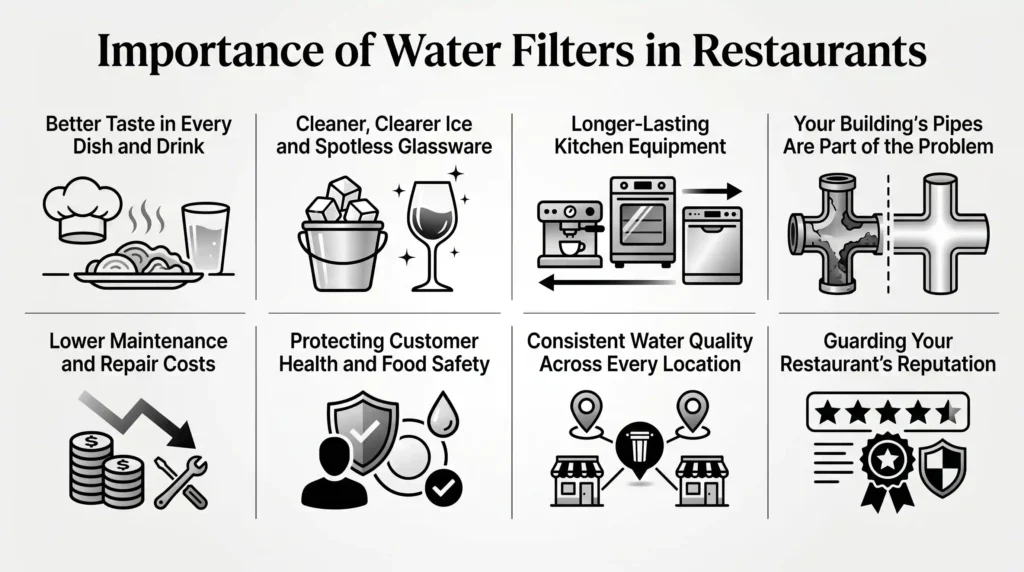
Installing water filters in restaurants results in better-tasting coffee and beverages, enhances the flavors of your dishes, keeps your glassware spotless, helps your equipment last longer, lowers repair costs, protects your plumbing pipes, and safeguards your reputation as well as your customers’ health.
Let’s break down all these benefits, one by one, here.
Bad Water Makes Good Food Taste Average
Chlorine does its job well in the municipal supply as it kills bacteria. However, the problem is that it doesn’t disappear before it reaches your espresso machine or your stockpot. Chlorine suppresses the volatile compounds that give coffee its character, leaving a flat, chemical edge in tea and fountain drinks. Customers won’t always know why something tastes wrong. They’ll just stop ordering it.
Hard water adds a second layer of problems. The dissolved calcium and magnesium it carries affect bread dough density, interfere with how flavors develop in soups and sauces, and dull the finish on everything from sparkling water to broth. A proper restaurant water filter system removes both issues at the source.
Cleaner, Clearer Ice and Spotless Glassware
When hard water dries up, it leaves mineral residue (that of calcium and magnesium—the notorious hardness minerals). This deposit, along with sediment produces cloudy ice cubes, filmy glasses, and spotted plates that don’t go away even after a full dishwasher cycle.
Customers don’t care about the chemistry; they see a spotted wine glass and assume the kitchen is dirty. That’s a reputational hit with no connection to how well your kitchen actually operates.
Filtration removes the hardness and sediment causing it. The ice comes out clear, the glassware dries spot-free, and the impression your restaurant makes lines up with the standard you hold yourself to.
Longer-Lasting Kitchen Equipment
Calcium and magnesium don’t rinse away; they accumulate. Inside an espresso machine, deposits build up on boiler elements. Inside a steamer or combi oven, they coat heating coils and reduce thermal efficiency. Inside an ice machine, they narrow the water lines and strain the compressor. Performance drops, components wear faster, and repair calls follow.
Commercial kitchen equipment is a significant capital investment. A commercial espresso machine alone can run well into five figures. Scale damage is almost entirely preventable, and using the right water filter for commercial kitchens is one of the lowest-cost ways to protect that equipment and extend its lifespan.
Reactive Repairs Cost More Than Prevention
Equipment running on unfiltered water needs more frequent descaling, more service visits, and more parts in replacement. An ice machine that fails on a Friday dinner service isn’t just a maintenance inconvenience. It’s lost revenue, a disrupted floor, and a scramble that affects the rest of the night.
The ongoing cost of a properly maintained filtration system is consistently lower than the cumulative cost of avoidable repairs. Doing nothing isn’t the low-cost option. It just delays the inevitable.
Your Building’s Pipes Are Part of the Problem
Most restaurant owners focus on the municipal supply, but that’s often not where the problem originates. According to the EPA, lead typically enters drinking water after it leaves the treatment plant, through corroded pipes, fittings, and fixtures inside the building itself.
Older commercial buildings, converted storefronts, and city center locations commonly have aging pipe infrastructure that introduces rust, sediment, and heavy metals into the water after it’s already been treated upstream.
The municipal supply can be perfectly clean. The building plumbing still introduces its own variables. A point-of-use filtration system in the kitchen intercepts whatever the infrastructure adds before it reaches your prep surfaces or your guests.
Water Safety Is a Kitchen Responsibility
Unfiltered water can carry chlorine byproducts, lead, mercury, sediment, and, in some cases, bacteria, all of which can end up in ice, cooking water, and food preparation. The EPA regulates over 90 contaminants in public drinking water, but municipal treatment has limits, and building distribution systems introduce additional variables that aren’t always controlled at the source.
Restaurants carry a real responsibility for everything that reaches the table. Proper filtration is basic due diligence. It’s verifiable, practical, and addresses risk right where it arises.
Consistent Water Means Consistent Food
For restaurant groups operating across multiple sites, water quality isn’t uniform. Municipal supply varies by area, building infrastructure varies by age, and seasonal treatment changes affect chlorine levels and mineral content throughout the year.
Standardized commercial water filtration for restaurants ensures the coffee at your busiest location tastes the same as the one at your newest.
For independent restaurants, this matters within a single site across seasons. Water conditions shift. Filtration removes that variable, so dishes stay consistent regardless of what’s happening to the water upstream.
Protect the Reputation You Built
A waterborne illness event, even a minor one, doesn’t stay contained. It shows up in Google reviews, gets shared, and the coverage rarely comes with nuance or context.
Reputation damage from a single contamination incident tends to be disproportionate to what actually happened, and recovering from it takes longer than most operators expect.
Filtration is ‘reputation insurance.’ It’s a proactive, documentable commitment to food safety, one that health inspectors, insurance underwriters, and customers can all verify. The restaurants that treat water quality in restaurants as a standard rather than an afterthought are the ones that have a long line of recurring customers.
Finding the Right Water Filter For Your Restaurant
Understanding why filtration matters is step one. Knowing which system actually fits your operation is step two, and the two aren’t the same question.
Test Your Water First
Before you buy anything, test your water. A professional water quality test (like the one by WaterMart and that too, completely free of cost) tells you what’s actually in your supply, including hardness levels, chlorine concentration, sediment load, heavy metals, and bacterial indicators.
Without it, you’re just guessing, and guessing leads to buying the wrong system: one that doesn’t address your actual problem and won’t perform the way you expect. This step comes before the purchase, not after.
Not Every Filter Fits Every Kitchen
Different equipment has different filtration needs.
- Coffee and espresso machines need chlorine and sediment removal, as unfiltered water produces flat flavor and deposits that degrade internal components over time.
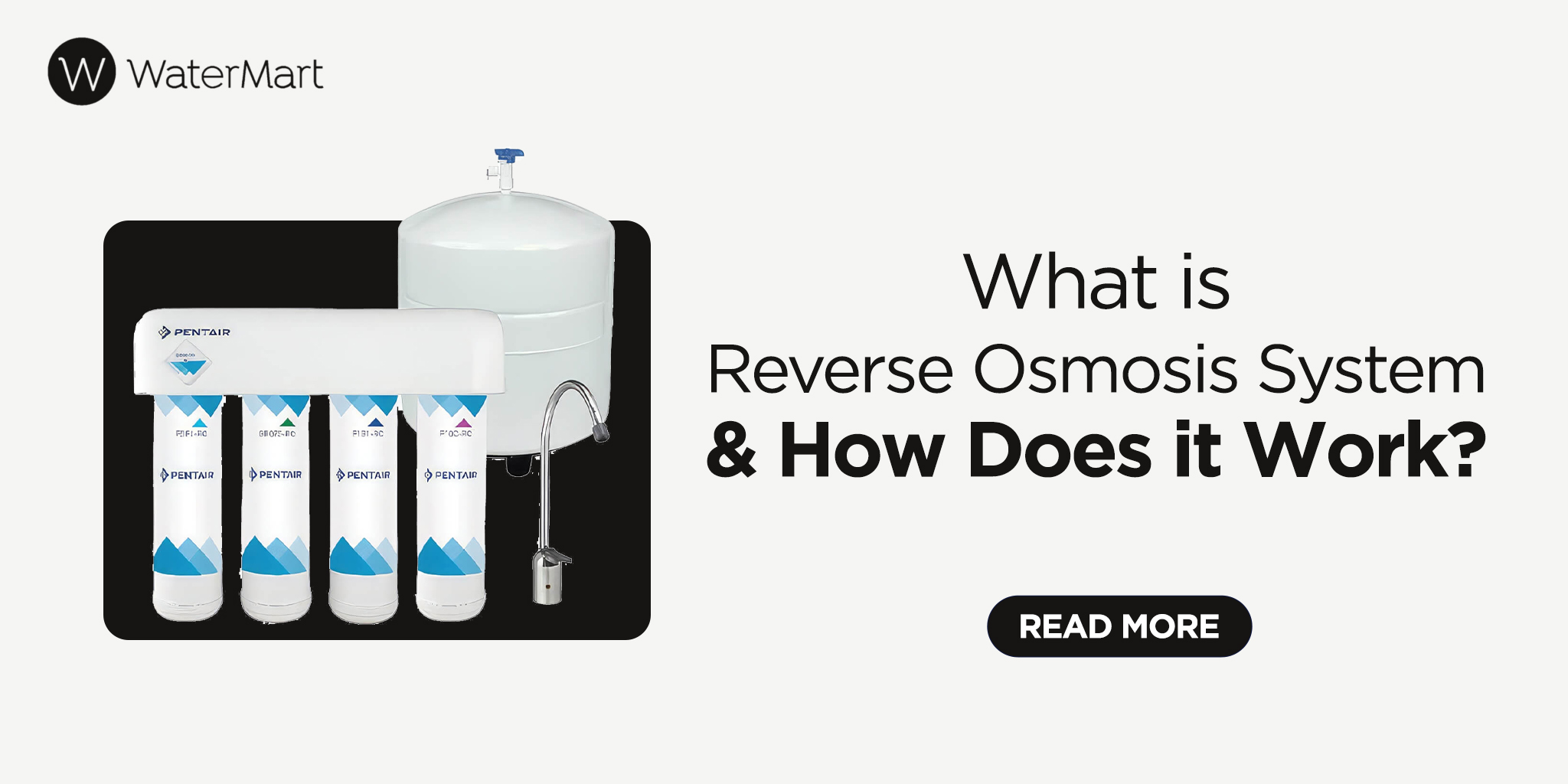
- Ice machines benefit from carbon filtration or RO (Reverse Osmosis – a filtration process that removes dissolved solids from water) for clean, clear output.
- Dishwashers and steamers in hard-water areas need a softener running alongside a filter, not instead of one.
- Fountain drink lines specifically need chloramine reduction.
It’s also worth checking for NSF/ANSI certifications (third-party certifications that verify filter performance and safety) when evaluating any system. These are independent, third-party certifications, and they tell you the system actually performs the way the manufacturer claims.
- NSF/ANSI 42 covers chlorine, taste, and odour reduction.
NSF/ANSI 53 covers health-related contaminants like lead and volatile organic compounds.
Don’t Undersize Your System
A system rated for light commercial or residential use won’t keep pace with a busy service. When the system can’t handle throughput, filtration effectiveness drops and water pressure can suffer at critical moments. When evaluating any commercial system, ask about GPM (gallons per minute) and confirm it’s rated for your peak demand, not just your daily average.
Factor in Replace & Maintenance Before You Buy
The best filtration system on the market performs no better than no system at all if you don’t maintain it. Before committing, factor in ongoing cartridge and membrane replacement costs into the purchase decision.
As a general guide, the recommended replacement schedule should be:
- Carbon filters: every 6–12 months
- Sediment pre-filters: every 3–6 months
- RO membranes: every 2–3 years
High-volume kitchens should be replaced on the shorter end of each range. Build it into the operational calendar from day one.
FAQs
Is a commercial water filter really necessary for restaurants?
Commercial kitchens need systems rated for high-volume and continuous use and certified to NSF/ANSI standards for food-contact applications. A residential filter isn’t built for commercial throughput and will underperform quickly under kitchen conditions.
How much do commercial water filters cost?
The range is wide, from entry-level carbon setups to multi-stage RO systems built for high-volume operations. Ongoing cartridge and membrane replacement adds to the annual cost. Getting a water test before purchasing helps avoid buying more systems than you need or less than your kitchen requires.
What’s the replacement schedule for restaurant water filters?
It depends on the filter type and how much water your kitchen moves through. Carbon filters: every 6–12 months. Sediment pre-filters: every 3–6 months. RO membranes: every 2–3 years. Busy, high-volume operations should work on the shorter end of each interval, as higher usage wears more over time.
Can I use a water softener instead of a water filter?
No, they solve different problems. A softener removes hardness minerals like calcium and magnesium. A filter removes contaminants like chlorine, sediment, heavy metals, and bacteria. Most commercial kitchens benefit from running both together. One doesn’t replace the other.
Which kitchen equipment needs a water filter?
Ice machines, espresso and coffee equipment, fountain drink dispensers, steamers, combi ovens, and dishwashers all benefit from filtration. If budget is a constraint, prioritise the ice machine and espresso equipment first, as they’re the most sensitive to water quality and the most expensive to repair when problems develop.
Do health codes require filtered water in restaurants?
Requirements vary by jurisdiction. Many health codes require potable water that meets specific safety standards, and filtration is often the most practical way to consistently meet them. Check with your local health authority for the exact requirements in your area rather than assuming that the municipal supply covers everything.
Your Water Deserves the Same Attention as Your Ingredients
Water quality is one of the most overlooked foundations of food quality, yet it influences everything from taste and consistency to equipment performance in a restaurant kitchen. When it’s not properly managed, even the best ingredients can fall short of expectations.
The most practical first step for any restaurant is to test the water supply. This gives you a clear picture of what you’re dealing with. From there, you can put the right filtration in place to support consistent performance across your kitchen and protect your equipment over the long term. Watermart’s water filtration systems for restaurants are matched to your equipment, water, and usage volume. They help improve taste consistency, protect kitchen equipment, and reduce maintenance costs.