How To Check Water Quality | Indicators of Water Quality & Testing Methods
Every time you use water from the kitchen faucet, you are trusting it to be clean and safe. But trust isn’t enough to rely on the water quality. Even municipally treated water in Canada can have contaminants, and most impurities don’t come with any color, smell, or taste. Lead doesn’t leave a warning label. Neither do bacteria, pesticide residue, or microplastics. That’s exactly why you must know how to test your home water quality.
In this guide, we will walk you through how to check water quality using professional water quality testing procedures, DIY kits, and even a simple soap test. You will also learn about indicators of water quality, when and why to test the water, the common water contaminants, what to test for when using city and well water, and the benefits of regular testing so you can take the right action at the right time. By the end, you’ll know exactly how to test if your tap water is safe to drink.
You can check your water quality in three ways: get a certified laboratory test (most accurate), use a home test strip kit (affordable and quick, but less reliable than a professional test), or conduct a simple soap test to check for hard water. City water users must check their annual municipal water quality report. Well water owners must test privately, as there is no government oversight.
Key Takeaways
- Test your water regularly, not only when you suspect an issue. Get a professional water assessment at least once a year for bacteria (E. coli and coliforms) and every 2 to 5 years for chemical contaminants like lead, arsenic, and nitrates. Well owners should test twice a year.
- Look for warning signs that require immediate testing. Rotten egg odor (hydrogen sulfide), metallic taste (lead or iron), white scale buildup (hardness), recurring stomach illness (bacteria), and cloudy water (sediment) are all indicators that something is wrong with your water.
- Get the right test for your needs. DIY test strips are fast and economical, but they are viable for screening hardness, pH, and chlorine. Only certified laboratory testing or professional in-home testing can reliably detect low levels of dangerous contaminants like arsenic, bacteria, and lead.
- City water and well water face different risks. City water users should get tests for lead, copper, chlorine byproducts like trihalomethanes, and PFAS. Well water owners need to get their own testing and must prioritize bacteria, nitrates, and naturally occurring arsenic in the water.
- Regular testing shields your health from long-term issues and your wallet from costly repairs and treatments.
Why and When Should You Test Your Water?
Testing your home’s water quality is essential to protect your family’s health, appliances and fixtures, and plumbing systems. Knowing what’s in your water allows you to choose the right protective measures in case the water is contaminated.
Municipal water in Canada undergoes rigorous treatment in compliance with the federal guidelines. That said, contaminants such as lead can seep into your water through household plumbing fixtures or aging pipes. Agricultural runoff from fertilizers and pesticides can introduce nitrates, phosphates, and sulfates into water.
And while chlorine used in water treatment plants to disinfect the water doesn’t make it unsafe, it does impart an unpleasant smell and taste to the water.
Water sources are also at risk of containing organic material and sediment from soil erosion, microplastics from biosolids application and agricultural plastic use, and naturally occurring impurities such as arsenic in bedrock that can be mobilized due to agricultural activities.
If you rely on well water, you are solely responsible for ensuring your drinking water is fit for consumption. Bacterial contamination is often high in well water sources. This discussion just proves one point: you must measure your tap water quality. But how to know you should test your water?
When to Test Your Drinking Water’s Quality?
Several indicators of water quality alert you about potential problems. Get your water tested immediately if you notice the following signs:
- Metallic taste in the water, which is indicative of iron or lead contamination.
- Rotten egg odor means your water contains hydrogen sulfide.
- Discolored or cloudy water points to suspended particles or sediment.
- Stubborn stains on your laundry and sinks suggest manganese or iron contamination
- White scale buildup on appliances and fixtures, and the soap failing to lather well signals water hardness, which happens due to calcium and magnesium in the water.
- Swimming pool like smell is a marker of excess chlorine used in disinfection
Beyond these signs, get a professional water assessment at least once every year for microbial contaminants such as coliform and E. coli. If you are concerned about chemical contamination in your water, test it every 2 to 5 years.
In case of the following, get a professional water test right away:
- When yYou get any plumbing work in your home. Plumbing modifications disturb the pipes and solder, which can leach chemicals into your tap water.
- If there’s been any flooding in your area, that can affect your water line or well water.
- If any family member complains of gastrointestinal problems with no clear cause. It is likely the work of harmful bacteria and parasites in the water.
- If you are a new homeowner, get a water assessment as soon as possible. You don’t know the area’s water history.
- If you use well water, get it checked if you notice any change in the water’s appearance, odor, or taste, even if the scheduled test isn’t due.
How to Test Water Quality
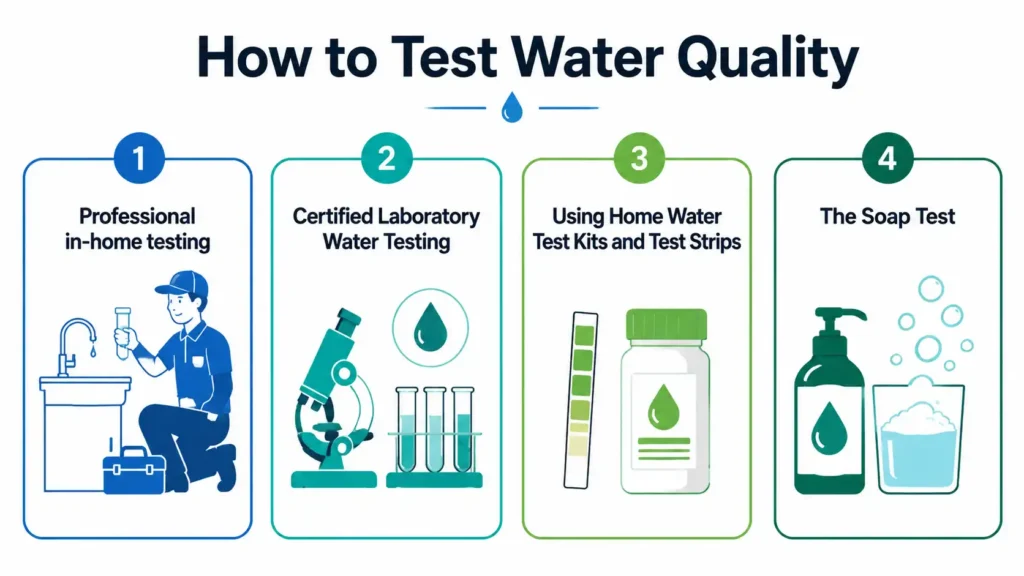
To test the water quality at home, you can use a DIY test kit, have it professionally checked at a laboratory, or have a technician visit your home and measure the water quality. If you’re concerned about hard water in your home, you can carry out a simple soap test.
Let’s walk you through each of these water quality testing methods to assess your tap water quality and check for contaminants.
Professional In-Home Testing
Professional in-home water testing is by far the most convenient way to check for contamination in your tap water without handling shipping or sample bottles. A certified technician visits your home and assesses your tap water quality using calibrated equipment. Usually, you get immediate results for water quality testing parameters such as iron, hardness, total dissolved solids (TDS), pH, and chlorine.
This is a very helpful option for homeowners who are seeking a quick snapshot of their water quality issues before choosing a suitable treatment solution. Many premium water treatment companies, like WaterMart provide free professional water assessment as a first step to understand your water.
Schedule Your Free Water Test
Let our experienced Watermart team test your water and provide customized recommendations to address your water concerns.
Certified Laboratory Water Testing
Certified laboratory water testing is the gold standard for the most accurate and legally defensible results. These labs adhere to stringent water quality testing standards and use cutting-edge instruments to detect contaminants down to parts per billion.
Homeowners in Canada should look for labs accredited by the Canadian Association for Laboratory Accreditation (CALA). If you can’t find any such laboratory nearby, opt for one that your provincial health authority recognizes.
Follow the steps below to test water quality for drinking and other purposes through a lab:
- Contact your provincial drinking water authority or local public health unit to get a list of accredited laboratories.
- Once you choose a lab, ask them about the next steps you need to execute. They will provide you with special sample bottles and guide you on how to collect a sample.
- Sampling procedures vary depending on what you’re testing your water for.
- To check for bacteria, sample from a cold water tap, but don’t forget to flush it for 5 to 10 minutes. Don’t rinse the bottle as it contains a preservative.
- To test for chemical impurities (copper, arsenic, lead, etc.), you need to collect the sample a little differently. Collect it first thing in the morning after water has rested in your pipes for a minimum of 6 to 7 hours. When collecting the sample, don’t flush the tap. The stagnant sample shows the amount of lead that leaches from your house’s plumbing systems.
- For specialized testing such as hydrocarbons, pesticides, and per- and polyfluoroalkyl substances (PFAS), ask the lab about their specific requirements first. Typically, they require specialized bottles and handling procedures.
- The sample must stay cool but must not freeze. Keep the sample in a cooler with ice packs in a dark place until you deliver it to the laboratory.
- Return it to the lab within 24 hours for bacterial testing.
- If you want to check the water for other chemical parameters, the lab will advise you on specific hold times.
- You will receive the results via mail, phone, or the lab’s online portal. Typically, it takes around 2 to 3 days to get results for bacterial testing and 6 to 8 weeks for complicated chemical assessment.
- If your sample is unsafe, a public health inspector will contact you only then. If you don’t hear back from the lab within 4 days, it means your bacterial test was negative for the concerns you had, and there’s nothing to worry about.
- For chemical test results, you will need to compare them against the Guidelines for Canadian Drinking Water Quality established by Health Canada.
Using Home Water Test Kits and Test Strips
If you are looking for a fast and affordable way to test your tap water at home, get a home test kit or test strip. These DIY water quality testing kits are appropriate to measure chlorine, pH, nitrates, hardness, nitrites, copper, iron, and sometimes even lead.
Here’s how you can test water for contaminants with home testing kits.
- Get a water testing kit. You can find it at ‘The Home Depot Canada’ for around $50. Kits are also readily available on online stores, including Amazon.
- If you want to check hardness, pH, or lead in your water, a simple dip-and-read test kit works just fine. Take a small sample of water, around 5 to 10 mL, in a clean glass or container. Dip a strip into a water sample, wait a minute, and compare the color changes to a chart.
- If you are concerned about bacterial contamination in your tap water, you will need a specialized in-home bacterial test kit. It comes with a specific, sterile vial. Fill the vial with water to a marked fill line. Shake it to activate a pre-measured powder inside. Keep the vial upright at room temperature. Do not disturb it for around 24 to 48 hours. To understand the results, compare the liquid color to a chart included with the kit. Generally, purple suggests no bacterial detection. Yellow points to the presence of coliform bacteria, including E. coli. AquaVial is a renowned Canadian kit that uses a different scale: pink or purple indicates contamination, while yellow means the water is safe.
Are home water test kits reliable? Yes, they are, but only for screening purposes. They do alert you to potential issues and work fine for certain parameters only.
These kits do fall short of detecting low levels of hazardous impurities such as bacteria or lead. If you suspect serious water contamination, it is wise to opt for a certified lab test or professional in-home water testing.
The Soap Test (A Simple DIY Alternative)
The soap test is not a scientific water quality analysis technique. GTA struggles with water hardness, and homeowners often use it to detect if their water is hard.
Hard water contains high levels of calcium and magnesium, which lead to scale buildup on appliances and fixtures and also interfere with soap’s ability to lather.
Here’s how to test tap water quality for hardness with soap.
- Fill a clear bottle about halfway with tap water.
- Add 10 drops of liquid dish soap to the bottle.
- Shake the bottle vigorously for 10 to 15 seconds.
- If you get a rich, fluffy lather, your water is soft.
- If the water turns milky and some bubbles appear, it is likely you get hard water in your house.
This simple DIY soap test isn’t viable to check for heavy metals or bacteria. But yes, it is a quick method to check if your water is hard. If you do struggle with water, it is best to choose a reliable water softener or an advanced multistage filtration system.
Common Contaminants in Water
Contaminants found in Canadian drinking water generally fall into four main categories. Understanding them helps you know what to detect in your water and what to get it tested for. The table below gives a quick overview of the contaminant types, what they include, where they come from, and the health risks they impose.
| Contaminant Type | What It Includes | Where It Comes From | Health Risks |
| Biological | E. coli, Giardia, norovirus | Human/animal waste, septic leaks, farm runoff | Stomach illness, nausea, diarrhea |
| Chemical | Lead, arsenic, nitrates, pesticides, PFAS | Natural geology, industrial waste, fertilizers, old pipes | Organ damage, cancer, neurological effects, blue baby syndrome |
| Physical | Sediment, silt, microplastics | Soil erosion, decaying plants, aging pipes | Usually it just influences the water’s taste or appearance. Can hide germs from disinfection |
| Radiological | Uranium, radium, radon | Natural bedrock (common in some Canadian regions) | Kidney damage, increased cancer risk |
The four kinds of impurities found in Canadian tap water include:
- Biological contaminants such as E. coli, Giardia, and norovirus come from animal and human waste, agricultural runoff, or septic leaks. They are notorious for causing diarrhea, nausea, and gastrointestinal illness and are particularly dangerous for young children or those with compromised immune systems.
- Chemical contaminants include arsenic, nitrates, pesticides, and PFAS. These make their way into water from farming, aging pipes, industrial discharge, or natural geology. Long-term exposure to these contaminants can lead to neurological issues, organ damage, cancer, and blue baby syndrome from nitrates.
- Physical contaminants refer to the particles you can see: microplastics, silt, sediment, and organic material. They enter water from aging pipes, decaying plants, or soil erosion. These present an aesthetic issue that impacts the water’s taste, appearance, or smell, such as cloudiness, discoloration, or unpleasant taste, but don’t necessarily make you sick. However, these particles can harbor harmful microorganisms and protect them against disinfection.
- Radiological contaminants like radium, radon, or uranium occur naturally in bedrock, especially in some Canadian regions. Long-term exposure puts you at risk of certain cancers and kidney damage.
What Should City and Well Water Users Test For?
What you need to test your water for depends entirely on your main water source. Well and city water struggle with different risks, so you need to select the quality testing parameters accordingly.
For City Water Users
Municipal water meets the Guidelines for Canadian Drinking Water Quality, but it often picks up contaminants en route from the treatment plant to your home. Here’s how to test city water quality the right way.
Municipal water users should be on the lookout for these contaminants in their water:
- Lead and copper leach from solder, brass fixtures, and old pipes, not from the treatment plant. Homes constructed before 1990 are at the highest risk of heavy metal contamination in their water.
- Chlorine and chloramines are used as disinfectants in water treatment plants. While they do a powerful job at killing impurities, they normally leave an unpleasant odor and taste and can form byproducts like trihalomethanes, which are associated with central nervous system, kidney, and liver problems.
- PFAS (per- and polyfluoroalkyl substances) are also known as ‘forever chemicals’, and are emerging contaminants that conventional water treatment is incapable of removing. Health Canada has established a drinking water objective of 30 nanograms/liter for a total of 25 specific PFAS compounds.
- Hardness minerals (calcium and magnesium) don’t really inflict a health risk but reduce soap effectiveness and cause scale buildup that gradually hurts the plumbing and deteriorates the efficiency of appliances.
Contact your municipal office to access your local water quality report. Review it for any exceedances of Health Canada’s Maximum Acceptable Concentrations (MAC).
For Well Water Users
Private well owners need to take care of their own water quality. No authority will check it for you. Health Canada recommends testing your well water at least twice a year for bacteria (E. coli and total coliforms).
Get one test done in the spring when spring rains and melting snow carry surface impurities like fertilizers and animal waste into groundwater. Schedule the second one in the fall when heavy autumn rains can flush bacteria right into your well.
For chemical contaminants, have your water tested every 2–5 years, or if you notice changes in taste, smell, or appearance.
Here’s how to know if well water is safe for consumption and what to test it for.
- E. coli and total coliforms point to fecal contamination. If the test results show E. coli, always boil the water to make it safe for drinking.
- Nitrates and nitrites are common in agricultural areas due to septic systems or fertilizer runoff. Infants under six months are particularly vulnerable.
- Arsenic occurs naturally in bedrock across parts of Canada, such as British Columbia, Labrador, New Brunswick, Nova Scotia, Yukon, and Newfoundland. Drinking water contaminated with arsenic can result in lung, kidney, and liver cancer in the long term.
- Iron and manganese usually occur in very low levels in most Canadian wells. While they aren’t really health hazards, they do stain your laundry and fixtures and affect the water’s taste.
- Copper and lead can seep into the water from well pumps, fittings, or pipes.
It is crucial for you as a well owner to get the well water tested. Get in touch with your local public health unit or provincial drinking water authority for a list of accredited laboratories in your area.
Many provinces have established regulatory frameworks that require municipal water systems to check for basic parameters like nitrates, chlorine residuals, total coliforms, and E. coli. However, Manitoba is currently the only province that offers a clear subsidized testing program for bacterial parameters for private well owners.
Why Should You Test Your Water Quality Regularly?
Regular water quality testing helps you know what’s in your water, helping you take timely action before small issues turn into serious health concerns and expensive problems. It protects your appliances, improves your skin and hair, extends the lifespan of plumbing systems and appliances, prevents scale buildup, and increases the efficiency of water heaters.
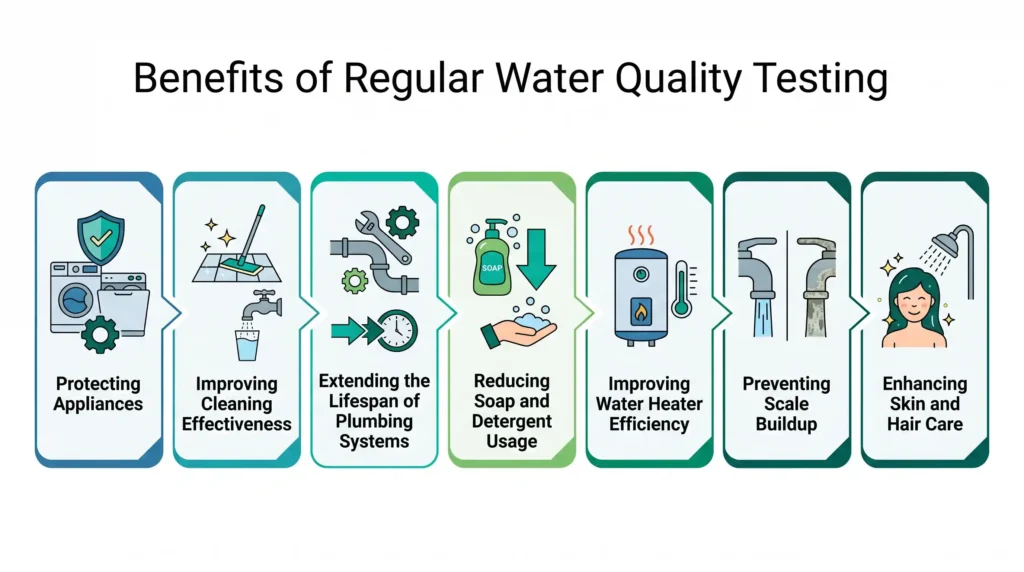
Let’s walk you through the many benefits of getting water quality tests on a regular basis.
- Protecting Appliances: Contaminants such as iron, hardness minerals, and sediment build up inside coffee makers, water heaters, and dishwashers, which decreases their efficiency and lifespan. Testing your water quality regularly helps you detect these issues before they damage your appliances.
- Improving Cleaning Effectiveness: Contaminants in water, mainly as calcium, magnesium, iron, manganese, and copper, react with soap to form scum, leaving residue on laundry, dishes, sinks, and appliances. Knowing your water quality helps you choose the right treatment, improving the cleaning effectiveness.
- Extending the Lifespan of Plumbing Systems: Over time, corrosive elements, minerals, and sediment can damage pipes from the inside, which reduces water pressure, eventually demanding expensive repiping. You can catch these issues way early with timely testing.
- Reducing Soap and Detergent Usage: Hardness minerals and other contaminants keep the soap and detergent from doing its job—forming a rich, foamy lather. Hence, you need to use more product to clean yourself, laundry, and dishes. With balanced water, you use less soap, shampoo, and detergent and save money.
- Improving Water Heater Efficiency: Scale and sediment buildup create an insulation layer inside the water heater, forcing it to work harder and use more energy. A water heater running on balanced water works efficiently.
- Preventing Scale Buildup: Once mineral scale forms inside appliances and pipes, it’s not only difficult to remove it; it’s also very costly. When you test your water regularly, you identify the problem on time and can successfully treat scale before it aggravates.
- Enhancing Skin and Hair Care: Hard water, chlorine, and other contaminants leave a thin film on hair and skin that causes irritation, dryness, and dullness. Your skin and hair quality keep worsening, even with using the best products. Water testing helps you know the hardness levels in your water, so you can fix the issue and go back to having healthy skin and hair.
Why Leave Your Water Quality to Guesswork? Get Professional Help!
Water quality issues are seldom simple. The same cloudy tap water could come from a municipal supply problem, seasonal fluctuations in the local reservoir, or aging pipes in your home. A DIY water test can work, but at the end of the day, it is guesswork. You never figure out the exact contaminant levels in your water, and more importantly, the precise root cause. This is where professional guidance stands out and turns uncertainty into clarity.
Let’s give you a quick comparison between relying on DIY tests and resorting to professional guidance.
Test Strips Expire. Professional Results are Verifiable
DIY water tests have a short shelf life. They can degrade in humidity or heat, giving incorrect readings. Professional lab analysis or professional in-home testing employs calibrated equipment with proper quality controls. You get reliable and verifiable results.
DIY Kits Can Miss Contaminants. Professional Testing Doesn’t
Most in-home kits check for water hardness, chlorine, pH, and maybe nitrates. They ignore heavy metals, dissolved solids, volatile organic compounds (VOCs), and bacteria that negatively influence your health in the long term.
On the contrary, professional water assessments screen your water for a complete spectrum of contaminants specific to your property and local water supply. They measure parameters such as heavy metals, bacteria, VOCs, chlorine byproducts such as trihalomethanes, nitrates, and pesticides against Maximum Acceptable Concentrations (MAC) and taste, odor, hardness minerals, and other appearance issues against Aesthetic Objectives (AO).
You get an authentic and holistic overview of what really lives in your water and how it affects your health and house.
User Error Can Skew DIY Results. Professional Testing Uses Strict Protocols.
User error and DIY testing go hand in hand. Dip a strip a few seconds too long, or read it under poor lighting, and your results could be wrong. You can get an idea of your water quality, but you cannot trust the DIY results.
Professional water testing follows strict quality protocols. It has standardized sampling, handling, testing, and reading procedures. Guesswork and human error are marginal to zero.
DIY Results Give You Hints. Professional Results Paint the Whole Picture.
With a DIY test kit, you get some idea of what might be wrong with your water. Perhaps, it has that chlorine smell. Or maybe it is hacked by hardness minerals. But, you will never get the full picture.
As opposed to this, professional testing paints a complete scenario of the problem. You understand exactly what’s wrong with your water and the levels of contaminants in it. Cherry on top? Trustworthy, top-rated water treatment companies like WaterMart also provide you with a helpful solution tailored to your specific problem.
Professional results are stored and documented so you can monitor seasonal changes, gauge the effectiveness of your chosen treatment system, and prove your water quality to inspectors, tenants, or insurance providers.
Yes, DIY tests are easy on the pocket. But incorrect problem identification only creates bigger problems and hefty expenses. Professional testing saves you time, stress, and lots of money too.
What Solutions Are Available to Improve Your Home’s Water?
Once you understand how to check water contamination and have your test results, the next step is choosing the right treatment. Different contaminants require different solutions. Here’s a quick overview of available options.
| Solution | Best For | How It Works |
| Reverse Osmosis Systems | Removing dissolved solids, heavy metals (lead, arsenic), nitrates, PFAS, and improving taste. Also removes up to 99% of microplastics | Forces water through a semi-permeable membrane with pores as small as 0.0001 microns |
| Water Softeners | Hardness minerals (calcium, magnesium) that cause scale buildup and soap scum | Ion exchange replaces calcium and magnesium with sodium or potassium |
| Multi-Stage Filtration Systems | Broad contaminant reduction, including sediment, chlorine, taste, and odor | Combines sediment, carbon, and sometimes RO or UV stages |
| Whole Home Filtration Systems | Treating all water entering the house—every tap, shower, and appliance | Installed at the main water line; can include sediment, carbon, and softening |
| UV Water Purifiers | Biological contaminants—bacteria, viruses, protozoa (Giardia, Cryptosporidium) | Ultraviolet light inactivates microorganisms by damaging their DNA |
| Activated Carbon Filters | Chlorine, chloramines, taste, odor, and some volatile organic compounds | Adsorption traps contaminants on the surface of the carbon media |
| Sediment Filters / Pre-filters | Sand, rust, silt, and visible particles that clog plumbing and damage appliances | Physical barrier traps particles larger than the filter’s micron rating |
| UF (Ultrafiltration) Systems | Bacteria, viruses, and particles, while retaining beneficial minerals | Membrane with pore size of 0.01–0.1 microns; does not remove dissolved solids |
| Water Conditioners / Anti-Scale Systems | Preventing scale without removing hardness minerals | Template-assisted crystallization or electromagnetic fields alter the crystal structure |
Explore WaterMart’s full range of water treatment systems to find the right solution for your home.
Frequently Asked Questions
Which tests best help determine water quality?
The most important water tests are for nitrates, bacteria (E. coli and total coliforms), total dissolved solids (TDS), hardness, and pH. If you use well water, check for arsenic and lead. If you use municipally treated city water, request your municipal water quality report and consider testing for lead from your household plumbing.
How to know if water is safe to drink?
Perhaps your water has taste, smell, or appearance issues, but these are aesthetic problems. To ensure your water is safe to drink, get a professional in-house test or a laboratory assessment because many contaminants are invisible to the naked eye.
What is the most important water quality test?
For well water, the bacterial test (E. coli and total coliforms) is most crucial because these pathogens can cause immediate illness. For city water, lead testing is important because of the associated health risks, especially for children and pregnant women.
How to read water test results?
Compare your results against the Guidelines for Canadian Drinking Water Quality. Health Canada has set guidelines known as ‘Maximum Acceptable Concentrations (MAC)’ for health-related impurities and ‘Aesthetic Objectives (AO)’ for aesthetic issues such as hardness, odor, and taste. If any parameter in your water test results exceeds the MAC, take corrective action immediately.
How to test river water quality?
Testing river water follows similar principles to testing tap water but has different objectives. For recreational use, test for pH, E. coli, and turbidity (relative clarity or cloudiness of a liquid.) For drinking water, the parameters are the same as those for well water. But do test for agricultural and industrial runoff contaminants if those sources are nearby.
How to test city water quality?
First, review your municipality’s annual water quality report. This tells you what the utility is testing and whether they comply with the guidelines. Next, test your tap water primarily for lead and copper, which can leach from your home’s plumbing after the water leaves the main.
How to know if well water is safe?
Regular water testing is the only way to know if your well water is safe for consumption. Test for bacteria every 6 months and for chemical contaminants (nitrates, arsenic, lead, metals) every 2 to 5 years. Test immediately if you observe changes in the water’s taste, smell, or appearance; there has been some plumbing work in your house; or your area experienced flooding recently.
How to detect contaminants in water?
You can detect common issues in water like nitrates, chlorine, and hardness minerals with home test strips. To test for wide-ranging contaminants and know their exact levels, get a professional in-home test or laboratory assessment. Use a soap test if you suspect water hardness. Your senses can also alert you to some issues: a chlorine smell points to disinfectant, cloudy water indicates sediment, and a metallic taste may suggest heavy metals.
How to test water quality without a kit?
If you don’t have a kit, use the soap test to detect water hardness. Also look for visual cues: white scale buildup suggests hardness, brown or orange stains suggest iron, and cloudy water suggests sediment. However, these indicators are not reliable substitutes for professional tests.
Cleaner Water Begins with Clarity
You can’t fix what you don’t measure. Testing your water quality is the fundamental step toward cleaner, safer, and healthier drinking water. Whether you use city water or a private well, start with a DIY home test, and then schedule a professional water assessment to figure out the precise contaminants and where the issues stem from.
However, if you are certain your water is unsafe, get professional help right away.
WaterMart has been helping Canadian homeowners get relief from water issues with advanced and custom solutions for over 30 years. Take the guesswork out of your water quality by scheduling your water test today.