Water Softener Resin: What It Is, How It Works, and When to Replace It
A water softener resin is the polymer bead filter media inside a water softener, which swaps the calcium and magnesium in the water with sodium and potassium, making the water soft and better tasting.
Being the backbone of every ion-exchange softening system, if a softener resin malfunctions, your whole water softener may go out of order.
Though a resin plays a critical role in water softening systems, users rarely understand its functioning and how to maintain it.
The better you understand resin in water softeners, the better you’ll be able to maintain your system. In this article, you’ll learn more about how resin works, its usual lifespan, its types, factors that affect its performance, and how to clean it effectively.
| Key Takeaways: Water softener resin is a synthetic ion-exchange media, tiny polystyrene beads that remove hardness minerals (calcium and magnesium) from water by swapping them for sodium ions. Resin sits in the resin tank and regenerates with salt brine and typically lasts 10–15 years under normal conditions. Understanding how your resin works helps you maintain it properly, spot problems early, and know when replacement is the right call. |
What is Water Softener Resin & How Does It Work?
Water softener resin, also called ion-exchange resin or resin media, is the active filtering material inside a water softener that actually removes hardness from your water. It consists of millions of tiny synthetic beads (negatively charged), each engineered to attract and hold calcium and magnesium ions as water passes through them. When you understand what resin is and how it functions, you get a clearer picture of why regular maintenance matters and what to watch for as your system ages.
How the Ion Exchange Process Works
The ion exchange process that takes place inside your water softener resin tank happens in three distinct phases:
- Service (Softening): Hard water enters the top of the resin tank and flows down through the bed of resin beads. Each bead carries a negative charge and is pre-loaded with sodium ions. As calcium and magnesium ions, which carry a stronger positive charge, pass through, they displace the sodium ions and bond to the resin. The water that exits the tank has had its hardness minerals removed and replaced with a small amount of sodium. It is now softened water.
- Regeneration: Over time, the resin beads become saturated with calcium and magnesium and can no longer soften water effectively. To restore capacity, the softener draws concentrated salt brine (sodium chloride solution) from the brine tank and flushes it through the resin. The high concentration of sodium ions displaces the captured hardness minerals, which are flushed down the drain along with the spent brine.
- Rinse: A final rinse of fresh water clears any remaining brine from the resin bed. The beads are now recharged with sodium ions and ready to soften water again. This full cycle typically takes 60–90 minutes and is programmed to occur automatically, usually at night when water demand is low.
How Much Resin is in a Water Softener?
The amount of resin in a water softener depends on the size of the resin tank, which is selected based on your household size and water hardness level. Large tanks carry a higher resin amount with more ion-exchange capacity, allowing them to soften a greater volume of water before needing regeneration.
| Tank Size | Resin Volume | Best For |
| 9″ x 48″ | 1.0 cu ft | 1–2 person household |
| 10″ x 54″ | 1.5 cu ft | 3–4 person household |
| 12″ x 52″ | 2.0 cu ft | 4–6 person household |
| 14″ x 65″ | 3.0 cu ft | Large home or high hardness |
If your household uses more water than average, or if your source water has high hardness (above 25 gpg, as is common in parts of Alberta, Saskatchewan, and rural Ontario), it is best to get a bigger resin tank than the standard recommendations.
What Is Water Softener Resin Made Of?
Water softener resin beads are made from polystyrene, a durable plastic polymer that has been cross-linked with divinylbenzene (DVB) during manufacturing. This cross-linking creates a rigid, porous bead structure that holds its shape under pressure and temperature changes, while also providing the charged surface area needed for ion exchange.
Each bead is roughly 0.3–1.2mm in diameter, about the size of a grain of fine sand, and carries a permanent negative (anionic) charge on its surface. This charge attracts positively charged ions like calcium (Ca²⁺) and magnesium (Mg²⁺) from hard water. The beads are pre-loaded with sodium ions (Na⁺), which are released into the water as the harder ions bond to the resin surface.
The percentage of DVB cross-linking determines the resin’s durability. Standard residential resin uses 8% DVB cross-linking; higher-grade resin uses 10%, making it more resistant to physical breakdown and chemical degradation from chlorine, an important consideration for homes on municipal water in Canadian cities.
What Is a Water Softener Resin Tank?
The resin tank is the main body of the water softener unit, a tall, cylindrical vessel, typically made of fiberglass or reinforced plastic, that houses the resin bed. Hard water enters through the top, flows through the resin bed, and exits softened through the bottom distributor tube. The control valve and timer assembly sit at the top of the resin tank and manage the service, regeneration, and rinse cycles automatically.
What Is a Resin Bed in a Water Softener?
The resin bed refers to the collective mass of resin beads packed inside the resin tank. It is not a single component but rather the bulk of loose beads, typically millions of them, that fill the tank to a specific level. The resin bed acts as the treatment zone where all ion exchange takes place. Over time, physical breakdown, chlorine exposure, and iron fouling (accumulation of iron, organic matter, and mineral deposits on the resin bead surface)can degrade the resin bed’s performance, which is why periodic cleaning and eventual replacement are necessary.
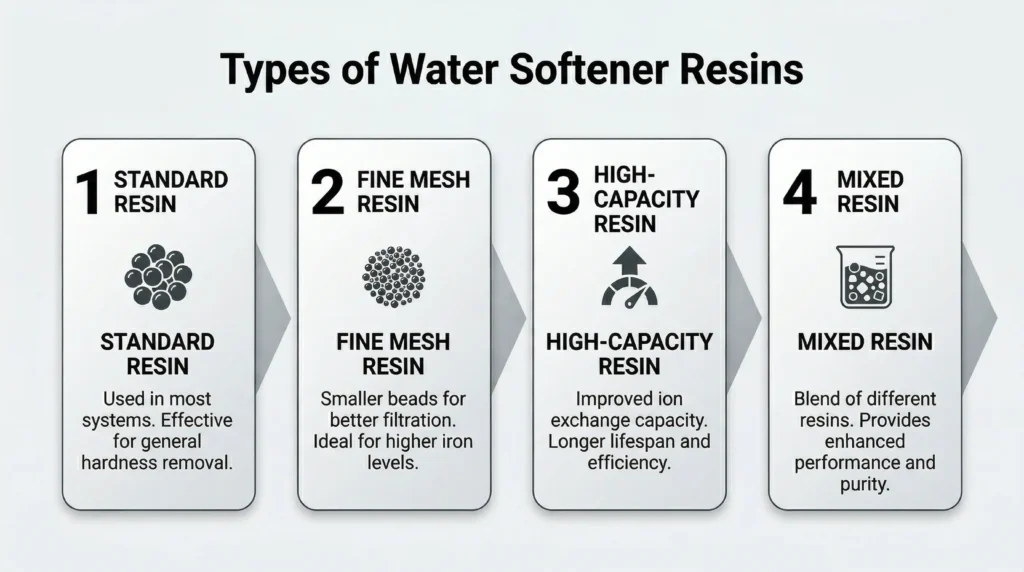
Types of Water Softener Resins
Not all types of water softener resin are the same. The right type for your softener depends on your water source, water chemistry, and how long you want it to last. For most Canadian homeowners and small businesses, there are three core types, and their applications are worth knowing about.
Standard (8% Cross-Link) Resin
Standard resin is the default choice for most residential water softeners, being the most affordable option across Canada. It uses 8% DVB cross-linking, making it effective at removing calcium and magnesium from typical municipal water.
- Lifespan: 10–15 years under normal conditions
- Best for: Canadian homes on municipal water with moderate hardness (up to ~25 gpg)
- Cost: Most affordable resin type
- Maintenance: Needs low upkeep, regular salt replenishment, and periodic resin cleaning
Fine Mesh Resin
Fine mesh resin uses smaller bead sizes than standard resin, increasing the surface area available for ion exchange. Large surface area enables the resin to capture dissolved iron (Fe²⁺) in addition to hardness minerals. This makes it the go-to choice for rural Canadian properties on well water, particularly in Ontario, where iron contamination is common.
- Lifespan: 8–12 years (slightly shorter due to iron loading)
- Best for: Well water with iron contamination alongside hardness
- Cost: Moderate, higher than standard
- Maintenance: Moderate, requires regular resin cleaning to prevent iron fouling
If your water leaves orange or rust-colored stains on fixtures and laundry, fine mesh resin, combined with proper regeneration programming, can address the problem that standard resin cannot.
High-Capacity (10% Cross-Link) Resin
High-capacity resin uses 10% DVB cross-linking, which produces a denser, more durable bead. This increased cross-linking makes it significantly more resistant to chlorine degradation, a critical factor for homes on chlorinated municipal water supplies in most Canadian cities. It also withstands physical stress better, which makes it last longer..
- Lifespan: 12–20 years
- Best for: Homes on chlorinated city water, high-usage households, or anyone wanting to minimize future replacement costs
- Cost: Moderate to premium, higher upfront cost, but lower cost-per-year over its lifespan
- Maintenance: Low
10% cross-link resin is best suited for homeowners seeking the longest possible replacement cycle with minimum maintenance requirements for years.
Macroporous/Specialty Resin
For water with higher organic content or tannins, choose a specially engineered macroporous resin with a highly porous bead structure that resists organic fouling.
It is best suited for people living in rural areas of British Columbia and Northern Ontario, who get water from lakes, rivers, or shallow wells.
| Feature | Standard | Fine Mesh | High Capacity | Specialty |
| Best For | General Hardness Removal | Iron + Hardness | High Chlorine Water | Organics/Mixed Needs |
| Bead Size | Standard (0.3 – 1.2mm) | Smaller | Standard | Varies |
| Life Span | 10-15 years | 8-12 Years | 12-20 Years | Varies |
| Cost | $130-$170 per cu ft | $140-$240 per cu ft | $30-$50 per cu ft | $ 15-$60 per cu ft |
| Maintenance | Low | Moderate | Low | Moderate- high |
What Is the Best Resin for Water Softeners?
There is no single “best” water softener resin; the right choice fully depends on your water quality and household needs. For most homes on Canadian municipal water with moderate hardness, standard- or high-capacity resin will serve you well. For well water users dealing with iron, fine mesh resin is the appropriate solution.
The most reliable way to choose the right resin is to start with a water test. Knowing your hardness level, iron content, and whether your supply is chlorinated gives you the data you need to make an informed decision rather than guesswork.
Not sure which resin your softener needs? WaterMart offers expert recommendations to find the best systems suiting your needs. Explore our water softening systems or contact us for a complimentary water test.
How to Clean Water Softener Resin
Your water softener’s life depends on how well its resin performs. You can optimize the resin’s efficiency by properly cleaning it regularly.
When and Why to Clean Your Resin
Regular regeneration flushes hardness minerals from resin beads. But over time, iron deposits, organic matter, and mineral buildup accumulate on the bead surfaces and inside the pores, a process known as “fouling.” Fouled resin loses ion-exchange capacity, meaning your softener works harder, uses more salt, and delivers less consistent results.
Signs that your resin needs cleaning include:
- Reduced water softness, which makes water feel harder than usual, even though salt is present
- Increased salt consumption without any improvement in water softening
- Return of iron staining on sinks, tubs, or laundry
- Slimy or discoloured water after regeneration
For most Canadian homes, resin cleaning is recommended every 3–6 months. Homes with iron-heavy well water, or those with older softeners, may benefit from more frequent treatment.
Step-by-Step Resin Cleaning Process
Resin cleaners, such as Iron Out or Res-Up, are specially formulated liquid or powder solutions that dissolve iron deposits, organic fouling, and mineral buildup from resin bead surfaces. They work in conjunction with your softener’s regeneration cycle to flush the loosened contaminants down the drain. Here’s how to use them:
- Choose the right cleaner: Select a resin cleaner appropriate for your primary problem, iron-focused cleaners (like Iron Out) for iron fouling, and general resin cleaners (like Res-Up) for mineral and organic buildup.
- Check the dosage instructions: Most products specify an amount based on your tank size. Using too little is ineffective; too much can leave residue.
- Pour the cleaner into the brine tank: Add the measured amount directly to the brine tank, not into the resin tank. It will be drawn through the system during regeneration.
- Run a manual regeneration cycle: Initiate a manual regeneration from your softener’s control panel. This pulls the cleaner through the resin bed and flushes it out.
- Repeat if needed: Heavily fouled resin, particularly from years of iron exposure, may require 2–3 treatment cycles before performance is fully restored. Allow 24 hours between treatments for optimum results.
Regular use of a resin cleaner (even when your softener seems to be performing well) is one of the simplest and most cost-effective ways to extend the life of your resin bed.
When and How to Replace Water Softener Resin
Knowing when to clean, when to change resin in a water softener, and how to do it right can save you hundreds of dollars and prevent the frustration of hard water sneaking back into your home. Here’s everything you need to make the right move.
Signs Your Resin Needs Replacing
Cleaning can restore fouled resin, but degraded resin cannot be rehabilitated. Here are the key indicators that replacement, not cleaning, is what your system needs:
- Hard water symptoms return despite regular regeneration and adequate salt levels
- Resin beads appear in your water, small amber or brown spheres visible at faucets, in toilet tanks, or caught in appliance filters
- Salt consumption increases significantly without improved softening performance
- Your softener is 10–15+ years old and has never had its resin replaced
- Multiple resin cleaning cycles fail to restore performance. If cleaning doesn’t help, the resin is likely degraded beyond recovery
How Long Does Water Softener Resin Last?
Under normal operating conditions, standard water softener resin lasts 10–15 years. High-capacity (10% cross-link) resin can last 15–20 years. However, several factors can shorten this lifespan significantly:
- Chlorine exposure: Municipal water containing chlorine (or chloramines) gradually degrades the polystyrene bead structure. Standard resin is more vulnerable than high-capacity resin. Homes in Canadian cities with heavily chlorinated water may see resin degrade faster than the 10-year baseline.
- Iron fouling: Dissolved iron in well water coats the resin beads and, over time, permanently blocks the ion-exchange sites even after cleaning. Fine mesh resin and regular cleaning help, but iron-heavy water will shorten resin life regardless.
- High water usage: More water volume passing through the resin means more regeneration cycles, more physical stress on the beads, and faster wear.
- Improper regeneration: Using the wrong salt type, insufficient salt levels, or infrequent regeneration accelerates bead degradation.
A properly maintained softener on clean municipal water with standard resin can realistically reach 15 years. The same unit on iron-heavy well water without regular resin cleaning may need replacement in 7–8 years. Knowing your water quality, through testing, is the best way to predict and plan for resin replacement.
Want to understand your water profile better? Call WaterMart to get a free water test and get recommendations about water softening systems and how they work in Canadian homes.
DIY Replacement: Step-by-Step
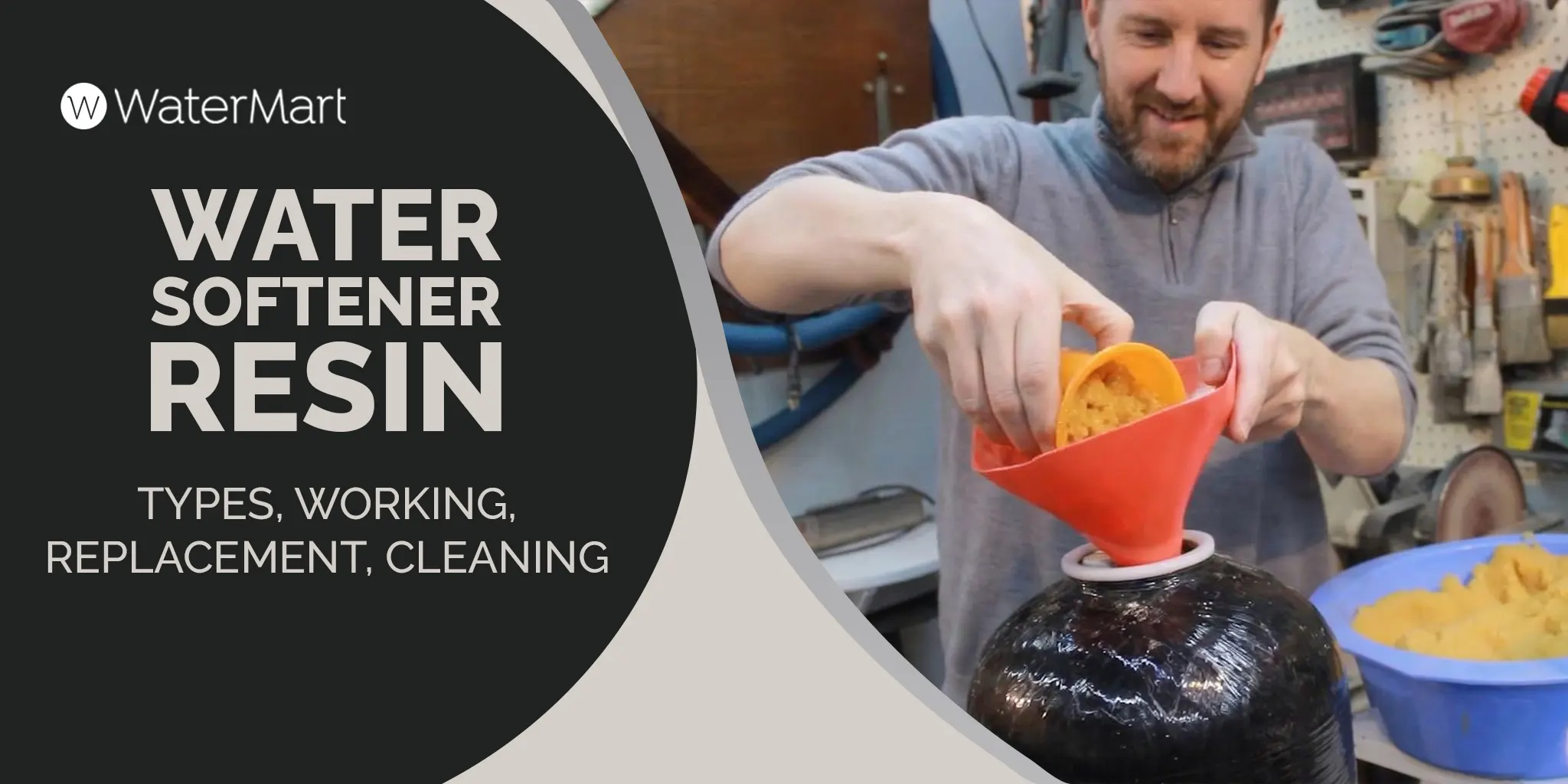
Resin replacement is a manageable DIY project for a confident homeowner with basic plumbing skills. Before you begin, prepare your workspace: bypass the softener, relieve water pressure by opening a nearby faucet, and have a bucket, wet/dry vacuum, and funnel on hand. Wear old clothes; resin beads can make a mess.
- Turn off the water supply and bypass the softener. Open a nearby faucet to relieve any residual water pressure in the system.
- Disconnect the softener from the plumbing. Take photos of all connections before disconnecting; you’ll thank yourself during reassembly.
- Remove the valve head and control assembly from the top of the resin tank. Set it aside carefully on a clean surface.
- Empty the old resin, tip the tank on its side, or use a wet/dry vacuum to remove the beads. Dispose of old resin in regular household garbage; it is non-toxic and not classified as hazardous waste in Canadian municipalities.
- Clean the inside of the tank with a mild bleach solution, then rinse thoroughly. Inspect the distributor tube and screen at the bottom for cracks or damage, and replace if necessary.
- Add the gravel base if your system requires it. Cover the distributor tube opening with tape or a cap before adding any resin. If beads get inside the tube, they will end up in your water lines. This is one of the most common and easily avoidable mistakes in DIY resin replacement.
- Pour in the new resin slowly using a funnel. Fill to the manufacturer’s recommended level for your tank size. Do not overfill.
- Reassemble the valve head, reconnect plumbing, and check all connections carefully for leaks.
- Sanitize and regenerate: run a manual regeneration cycle with the appropriate salt. Check for leaks again during the cycle. Run a tap for a few minutes to clear any residual sediment from the new resin.
Not confident doing this yourself? WaterMart offers professional resin replacement across Canada. Contact us today for a quote.
What Does Resin Replacement Cost?
Understanding the costs involved helps you decide between DIY, professional service, or full system replacement.
DIY cost: $80–$200 for resin media, depending on type (standard vs. high-capacity) and quantity. Add $10–$20 for a gravel underbed if required by your tank. Labor is your own time, typically 2–4 hours for a first-time replacement.
Professional replacement: $200–$500+, including labor and materials. Costs vary by tank size, resin type, and region in Canada. Urban areas like Toronto and Vancouver tend to be at the higher end of this range.
Resin replacement vs. new softener: If your unit is 15+ years old and the control valve, electronics, or brine tank is also showing problems, a full system replacement may be more cost-effective than a resin-only replacement. A new mid-range water softener costs $1000–$2000 installed but comes with a full warranty and updated technology. If only the resin is degraded and the rest of the unit is in good shape, replacing the resin alone is more cost-effective.
Is Water Softener Resin Dangerous?
This is a common concern, especially when resin beads appear in drinking water. Here’s the clear, factual answer:
Resin beads are non-toxic:
They are made of inert polystyrene, the same base polymer used in food-safe packaging and medical equipment. The beads do not leach harmful chemicals into your water under normal operating conditions.
The problem associated with beads appearing in water:
Small amber or brown spheres coming out of faucets typically mean the distributor screen inside the resin tank has cracked or the resin has degraded to the point where beads are breaking apart. This is a maintenance issue that needs to be addressed, not a health emergency.
Spent resin is not hazardous waste:
Old resin beads can be disposed of in regular household garbage in most Canadian municipalities. No special handling or disposal facility is required.
Regeneration adds a small amount of sodium to your water:
The ion exchange process replaces calcium and magnesium with sodium ions. For most people, this added sodium is negligible. However, if you are on a sodium-restricted diet for medical reasons, a reverse osmosis (RO) drinking water system installed at your kitchen tap can remove this sodium from your drinking and cooking water.
Frequently Asked Questions
How often should the resin in a water softener be replaced?
Most water softener resin lasts 10–15 years under normal conditions. High-capacity resin can last up to 20 years. However, factors like chlorine levels, iron content in your water, and overall usage can shorten this lifespan. If your softener is around 10 years old and performance is declining, a resin inspection or professional assessment can help decide further action plans.
Can I use mixed media resin in any softener?
Mixed media resin has different flow rate requirements and backwash needs compared to standard resin. Check your softener manufacturer’s specifications before switching, or consult a water treatment professional. Using the wrong resin type can reduce performance or damage your system.
Can I reuse old resin beads?
No. Once resin beads have degraded, whether from chlorine exposure, physical breakdown, or irreversible fouling, they cannot be restored to their original ion-exchange capacity. Attempting to reuse old resin will result in poor softening performance.
Does resin remove bacteria?
No. Ion-exchange resin is designed to remove dissolved minerals; it does not filter or kill bacteria, viruses, or other biological contaminants. If biological contamination is a concern, a UV disinfection system or whole-home filtration should be added to your water treatment setup.
How to tell if water softener resin is bad?
The clearest signs of degraded resin include hard water returning despite adequate salt and regular regeneration, visible resin beads in your tap water, significantly increased salt usage, and cleaning cycles that no longer restore performance. If two or three resin cleanings don’t improve your water quality, the resin has likely reached the end of its useful life.
Is resin water softener media safe?
Yes. Water softener resin is made of inert polystyrene beads that are safe for use in drinking water systems. They are NSF/ANSI certified for potable water contact and do not leach harmful chemicals under normal operating conditions.
Is it worth replacing resin in a water softener?
In most cases, yes, especially if the softener unit itself (valve, brine tank, control electronics) is still in good working order. Resin replacement typically costs $80–$500, depending on whether you DIY or hire a professional, compared to $1000–$2000 or more for a new system. If the unit is less than 15 years old and functioning properly apart from resin performance, replacement resin is almost always the better investment.
How often do you need to change the resin in a water softener?
For most homeowners, resin replacement is carried out every 10-15 years, depending upon the resin condition. It is not an annual maintenance item like salt replenishment, but it’s also not something you can ignore indefinitely. Scheduling a professional system inspection every few years helps catch resin degradation before it causes problems.
Can I replace water softener resin myself?
Yes, with the right preparation, DIY resin replacement is achievable for most homeowners. The key steps, including draining the tank, removing old resin, protecting the distributor tube, adding new resin, and running a regeneration cycle, are straightforward if you follow instructions carefully.
Final Thoughts – Keep Your Water Softener Running at Peak Performance
Water softener resin is the key to every effective softening system. With a lifespan of 10–15 years, it demands little attention, but ignoring it entirely comes at a cost. Clean it every 3–6 months, watch for warning signs like returning hardness or beads in your water, and plan for eventual replacement before performance suffers. The right resin, properly maintained, protects your plumbing, appliances, and water quality for years. WaterMart serves homeowners and businesses across Canada with expert water treatment solutions. Explore our water softening systems or contact our team to get started with free water testing.