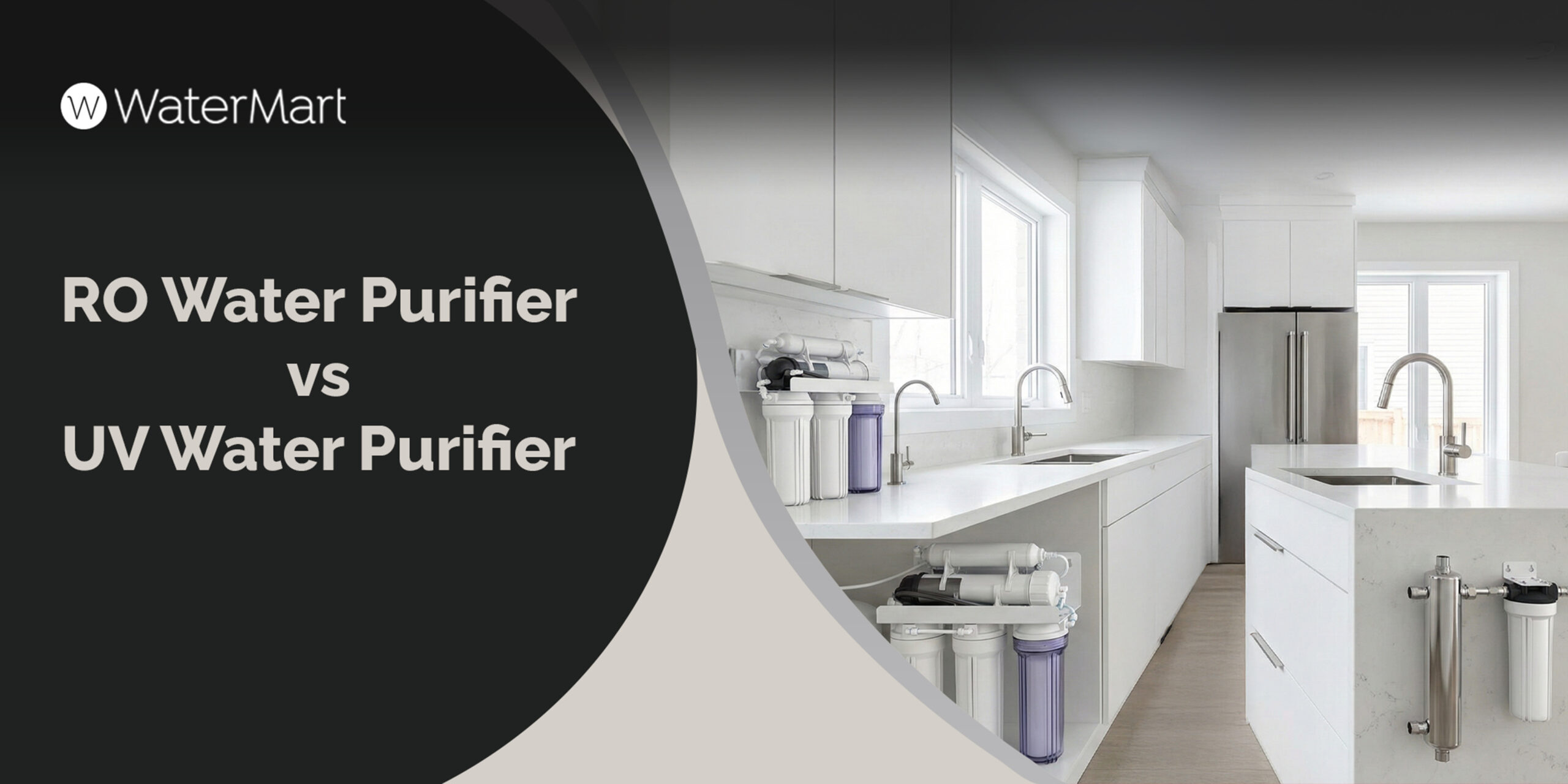
UV Water Purifier vs RO Purifier: Which One Is Best for You?
Deciding between a UV water purifier vs RO purifier is easy when you consider your water quality, needs, and priorities. UV purifiers are used to kill the germs, microbes and bacteria present in clear water(low TDS) using UV light.
While the RO system completely purifies the water(high TDS) from hard minerals, sediments, heavy metals, and other impurities using seperation method.
Both systems have different working principles, budgets, applications and offer purification solutions to different types of water. In this article, we’ll compare RO vs UV water purifiers in depth to help people decide which is best for their water quality.
The Factors That Make Water Safe or Risky
Water becomes unsafe when microbes, chemical contaminants, and physical impurities enter the supply. In Canada, households deal with issues linked to well water, surface water, or aging municipal lines. 2025 reports show metals, chlorine byproducts, and PFAS show up in some municipal systems.
Microbes like E. coli and Giardia can also slip into untreated or shallow sources. Sediment and rust from older plumbing change taste and colour. Because every region pulls water from different sources, the risks and effects aren’t the same everywhere, which is why testing matters before choosing any filtration system.
Get a free water test anywhere in Canada today. Based on the test, you can choose the most effective water purification system.
Key Water Parameters to Check Before Choosing a Purifier
Before selecting a water purifier, experts recommend checking core water parameters that show quality, safety, and taste. Here are some measurements to help understand contaminants and determine which system fits your water source.
TDS (Total Dissolved Solids)
TDS measures all dissolved salts, minerals, and metals in water. According to Canadian Health Guidelines, safe drinking water is below 500 ppm, and 50-150 ppm gives the best taste. High-TDS requires a Reverse Osmosis (RO) purifier.
Water Hardness
Hardness shows calcium and magnesium content, causing scale in pipes and appliances. Moderate to high hardness requires RO or water-softening filters & understanding the differences between a water softener and a descaler can help you choose the right solution for your home. Book a free water hardness test or test with strips.
Chlorine and Chemical Levels
Chlorine and chemicals like pesticides, solvents, or PFAS need to be checked if the water has a weird taste or odor (through strips or labs). Low levels can be removed by activated carbon filtration, while higher chemical concentrations require RO systems.
Basic Water Testing Methods
Basic water tests include simple visual checks, followed by test strips, digital meters, or a full lab report. These options reveal issues ranging from high solids to bacteria, giving a reliable base for choosing the right purifier.
RO vs UV Water Purifier – Key Differences
Here’s a working of both UV water purifier and reverse osmosis water purifier, so buyers can choose the right setup for their home.
What is a UV Water Purifier?
A UV purifier uses ultraviolet light to deactivate live microorganisms in water. It’s like a direct disinfection method that stops bacteria, viruses, and coliforms from multiplying. The system pushes water past a UV lamp, where the light hits the DNA of these organisms. This is the core of how UV water purification works. It is common in homes on well water or rural supply lines, as it reduces the risk of water-borne illness without adding chemicals.
Contaminants UV Removes:
- Bacteria
- Viruses
- Coliforms
- Giardia and Cryptosporidium (light-resistant forms may need a higher UV dose)
Contaminants UV Cannot Remove:
- Chlorine
- Heavy metals
- Pesticides and chemical pollutants
- Dissolved solids and minerals
- Sediment
Pros of UV Purifiers:
- Highly effective at killing microbes
- Chemical-free disinfection
- Retains natural minerals and taste
- Fast operation
- Lower maintenance (mostly annual lamp replacement)
UV Water Purifier Disadvantages:
- Needs clear water to work (an additional sediment pre-filter is needed because cloudy water blocks UV exposure)
- No chemical or sediment removal
- Bulb replacement required
- Requires electricity to power the UV lamp
What is an RO Water Purifier?
A Reverse Osmosis (RO) purifier uses a semipermeable membrane to push water through, removing dissolved solids, metals, chemicals, microplastics, and microscopic debris that standard filters cannot catch. RO systems are suitable for homes with varied contamination. Knowing What’s Reverse Osmosis System & how it works in detail would be great for a better understanding of this system.
Contaminants RO Removes:
- Microplastics
- Lead and arsenic
- PFAS/TDS
- Fluoride
- And more (around 99.9%)
Contaminants RO Cannot Remove:
- Waterborne gases
- Some volatile organics (unless paired with carbon)
RO Water Purifiers Advantages:
- Removes high-TDS and heavy metals
- Produces highly purified water
- Improves taste, odor, and clarity
- Ideal for hard water treatment and well sources
RO Water purifier disadvantages:
- Generates wastewater (more water consumption)
- Removes some natural minerals
- Higher maintenance with membrane and filter replacements
- Requires stable water pressure and electricity
Here’s a quick table for differences between RO and UV water purifiers:
| Features | RO Water Purifier | UV Water Purifier |
| Difference in Purification Technology | Membrane plus filters remove dissolved solids and impurities. | UV light kills bacteria and viruses. |
| Types of Contaminants Removed | Heavy metals, chemicals, salts, pesticides, microbes. | Microorganisms only. |
| TDS Handling | Reduces TDS. | Doesn’t reduce TDS. |
| Taste and Odour of Water | Better taste by removing dissolved impurities. | Keeps original taste; no chemical change. |
| Water Wastage and Energy Consumption | Produces wastewater; higher energy use. | No wastewater; lower energy use. |
| Maintenance Requirements | Regular filter and membrane changes. | Mostly UV lamp replacement. |
| Cost Comparison | Higher cost overall. | Lower cost overall. |
Choosing the Right Purifier for Your Needs
Wondering which water purifier is best, RO or UV? The answer depends on your water quality and budget. See this quick rule of thumb:
When to choose a UV purifier
Here’s when to use a UV water purifier:
- Your TDS stays below 200 ppm
- You primarily need microbial disinfection (municipal, lake-fed, treated supply)
- You want to retain natural minerals (no removal of salts, metals, or hardness)
When to choose a RO purifier
Here’s when to use a RO water purifier:
- TDS sits above 200 ppm
- Hardness is visible on taps, kettles, or filters
- You rely on borewell, trucked, or mixed supply with salts or chemical traces
- You need a comprehensive removal of heavy metals and chemicals.
- Taste and odor improvement is important.
- You have consistent water pressure and can manage maintenance costs.
When to choose the RO+UV combo
Choose RO+UV when your water has both high-TDS and a microbial load. This setup works for untreated borewell water, deep wells, and homes that switch between sources. RO handles dissolved solids and metals; UV covers bacteria and viruses.
Recommendations for Different Water Sources (municipal, borewell, cottage)
Based on field experience across Canadian homes, different sources need different systems.
- Municipal (Toronto, Vancouver, Ottawa): low-TDS level in water, so UV or UV+UF works well for routine microbial control.
- Borewell/Well (rural Ontario, Alberta acreages): high-TDS and hardness. Experts recommend RO or RO+UV for salts, metals, and microbes.
- Cottage/Cabin (Muskoka, BC interior): Water varies by season. Whole-home UV with a sediment filter works best. Add RO at the tap if TDS jumps.
Common Myths About RO and UV Purifiers
Still confused about online “claims” of each system? Here are clear explanations based on real performance.
UV Water Purifiers Add Chemicals to the Water
UV systems are chemical-free, and that’s one of the main advantages. It doesn’t add or remove chemicals or other dissolved contaminants.
UV Purifiers Make Water Look and Taste Better
No, UV only handles microbes. It does not remove particles, metals, chlorine, or anything that affects taste or clarity. For a cleaner appearance and better flavour, UV systems require pairing with sediment and carbon filtration.
UV Treatment Alone Is Enough for All Water Types
That is wrong. UV pruifers remove bacteria and viruses from water but cannot handle sediment, metals, pesticides, or high-TDS. Most homes connected with an untreated water supply or well water still need filters for particles and chemicals.
UV Systems Are Hard to Maintain
No, another advantage of UV water purifiers is that they need annual lamp replacement only. You can do it by yourself if there are no filters attached, as on its own, there are only four parts.
RO Removes All Healthy Minerals
Yes, RO removes nearly all dissolved minerals (99.9%), but most people already get the required nutrients from food. Many modern RO units add minerals back to improve taste, so users still get fresh-tasting drinking water.
RO Wastes a Lot of Water
That is true. RO uses extra water to protect the membrane, which creates a reject stream. Modern systems reduce this volume, and the leftover water can be reused for cleaning, plants, and other non-drinking tasks.
RO Alters the pH of Water Significantly
Removing minerals lowers buffering, so RO water becomes slightly acidic. This does not affect health, but it does change the pH of the water. Some systems add minerals back to raise pH and improve flavour for everyday use.
RO Systems Are Difficult to Maintain
Yes, if we compare it to other filtration systems, RO has multiple parts that involve upkeep and maintenance. Modern designs use quick-swap cartridges, and the membrane lasts for years. Today, most households manage these steps without needing a technician.
RO Systems Remove Beneficial Minerals
Yes. RO strips both harmful contaminants and natural minerals. Since diets supply most required minerals, this is not a concern. Many RO systems include a final stage that restores calcium and magnesium.
Steps to Find the Ideal RO and UV Water Purifier
UV light vs reverse osmosis isn’t a quick answer that you can find online. Here are the steps to take for a foolproof selection of a water purification system. Follow them by yourself or get help from experts:
1. Check Your Water Quality Before Buying
Test TDS, hardness, and contaminants using a home kit or report. Match the results with RO or UV needs, since each system targets different issues in daily use.
2. Look for Certifications
Check for NSF, WQA, or BIS marks to confirm verified performance. These labels show the system meets safety standards and handles the claims listed by the manufacturer.
3. Choose Between Tank and Tankless RO
Pick a tank model for steady storage or a tankless unit for fresh output and compact size. Base the choice on space, usage habits, and water flow. If you’d like, read the detailed comparison of reverse osmosis & carbon filter.
Final Verdict | UV water purifier vs RO purifier
Choosing the right system comes down to the actual contaminants in your water. Reverse osmosis vs ultraviolet water purifier is not a style choice; each solves a different problem, much like the comparison between reverse osmosis & carbon filter highlights how treatment methods vary. RO is the most reliable path for dissolved metals and high-TDS, while UV controls microbial risk. Combining RO with UV or UF technologies provides comprehensive purification, addressing both chemical and microbial contaminants. Many homes benefit from a combined approach, and you can start with a free water test. We’ll install the WaterMart Reverse Osmosis System that is best suited for your household’s water supply.
FAQs About RO vs UV Water Purifier
Yes, both RO and UV-treated water are safe to drink. RO lowers dissolved impurities, while UV disables germs. Together, they make water cleaner and healthier.
RO works better for high-TDS, hard water, and chemical contamination. UV works better for microbe-heavy water with low-TDS.
A combined RO+UV unit removes dissolved solids, metals, and chemicals and also disinfects germs. You get wider protection when water quality changes or is uncertain.
Well water usually carries high-TDS and microbial risks. Using both RO and UV gives safer results by handling dissolved impurities and disabling bacteria and viruses together.
RO blocks both harmful and harmless bacteria by physically filtering them out. UV doesn’t remove bacteria; it only targets harmful ones by damaging their DNA so they can’t multiply.
Yes. RO reduces chemicals, metals, and dissolved solids, while UV handles microbes. Together, they provide broader coverage when you are unsure about your well water quality.
Yes, UV light disables bacteria, viruses, and other microbes by damaging their DNA so they cannot multiply. It makes biologically contaminated water safer to drink.
RO removes chlorine through its carbon pre-filters. UV does not remove chlorine.
Yes, UV-treated water is microbially safe if the purifier works correctly. It keeps minerals and taste unchanged, but cannot fix high-TDS or chemical contamination.
Use RO when water has high-TDS, hardness, metals, salts, or chemical impurities. It’s also ideal for borewell, tanker, or well water with changing quality.
A combined RO+UV purifier is usually safest for kids. It lowers chemical risks and also disinfects germs, giving cleaner water for developing immune systems.