What Does WQA Certification Mean & Why Is It Important?
Every time you research a water filter, it is likely you come across terms like ‘tested’, ‘certified’, and ‘WQA-approved.’ Right? But what do these terms mean? This is quite a common frustration for homeowners wanting to make an informed purchase for their home. This guide clarifies what WQA certification is, its importance, and how to use this knowledge to make an intelligent choice.
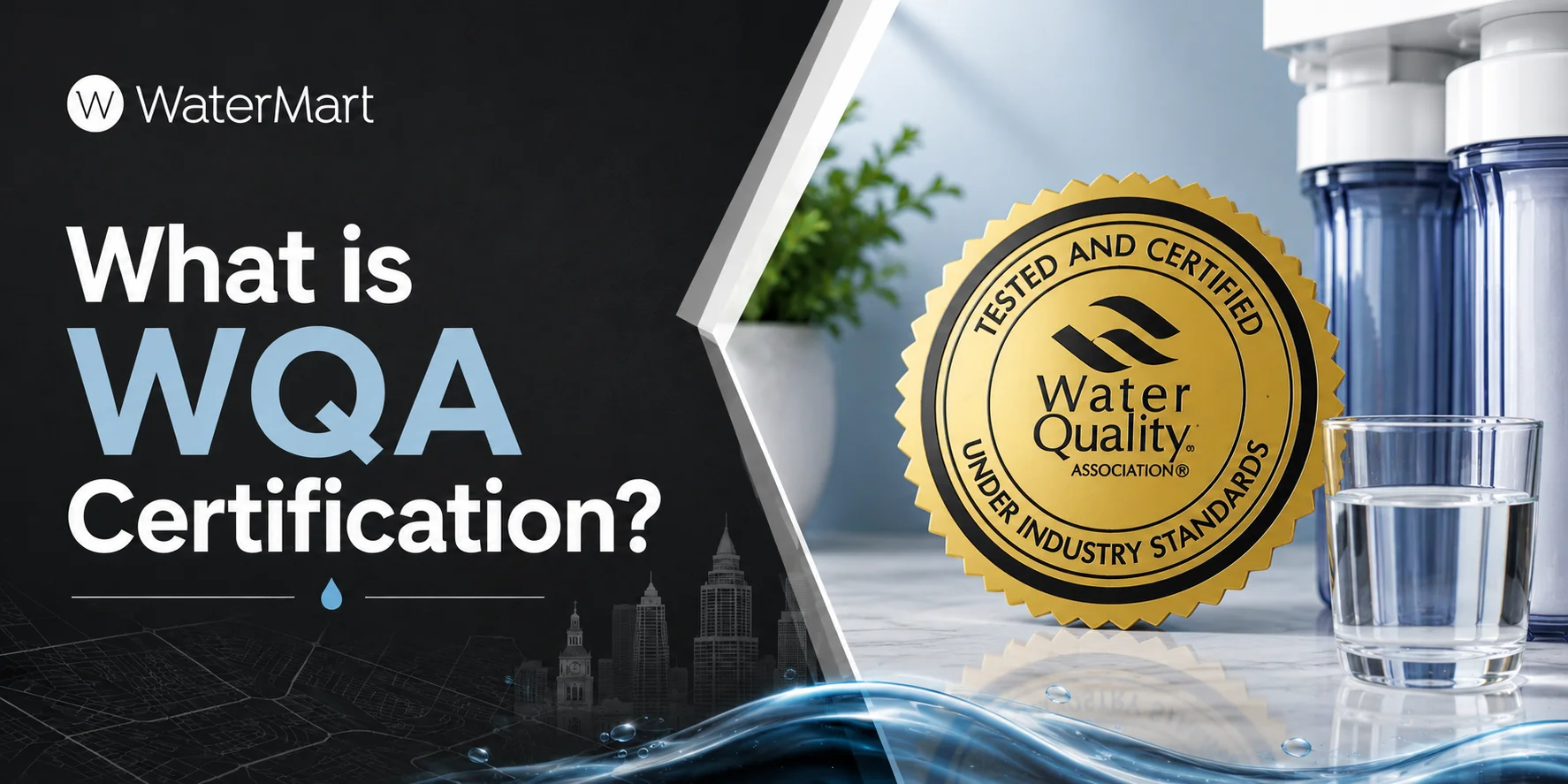
WQA stands for the Water Quality Association, a nonprofit international trade organization that serves the water treatment sector. Water treatment products bearing the WQA seal are trusted for independent testing and evaluation.
Let’s learn more about this today.
Key Takeaways
- WQA is short for Water Quality Association, an international organization dedicated to improving the water treatment industry.
- The WQA Gold Seal is an acclaimed product evaluation and certification program for water treatment products. When a product displays the Gold Seal, it means it has passed rigorous testing for material safety, structural integrity, and performance.
- WQA and NSF are competitors. Both are accredited third-party certification bodies that test products against the same NSF/ANSI standards. A product bearing the WQA certification is just as credible as one certified by NSF; neither is inherently superior.
- Instead of taking the manufacturer’s word for the certification, verify it yourself. You can confirm if your water treatment product is certified by looking it up on the WQA website.
What is WQA Certification?
Water Quality Association (WQA) is a not-for-profit global trade association that represents the water treatment industry and is dedicated to advancing it. Back in 1959, WQA started its comprehensive product evaluation and certification program known as the ‘WQA Gold Seal’, which is operational to date.
The WQA Gold Seal is accredited by the Standards Council of Canada (SCC) and the American National Standards Institute (ANSI). This additional seal of approval from two independent bodies signifies that WQA’s certification process complies with the stringent international standards set for reliability, quality, and credibility.
Products go through rigorous and elaborate testing procedures to gain the WQA water treatment certification.
- Material Safety Review: A thorough formulation review of every material used in manufacturing the product that is likely to touch the water. The review ensures the product’s materials won’t leach harmful contaminants into the drinking water.
- Structural Integrity Testing: Verifies that the water treatment product withstands normal water pressure without breaking or leaking.
- Performance Testing: Product undergoes strict tests to prove it removes the specific contaminants it claims to eliminate. If a filter claims to remove lead, it is tested for that specific impurity.
- Literature Review: All the performance data sheets, brochures, flyers, manuals, and other written materials are thoroughly reviewed to ascertain the marketing claims are genuine and not misleading.
- Annual Facility Inspections: On-site inspections at the product’s manufacturing facility at least once every year to guarantee quality excellence.
- Ongoing Monitoring: Continuous monitoring of the manufacturing process to re-evaluate any product changes.
An important point to remember is that the WQA certification applies to the specific product model being tested. It does not automatically apply to all the products that the company manufactures and sells.
Often, it so happens that a manufacturer has one certified water filter, but other products don’t carry the certification. So whenever you are buying a water purification product, check for the WQA Gold Seal on the product you are considering; don’t just look at the brand name.
The WQA not only certifies the international NSF/ANSI standards; it has created its own set of standards as well.
WQA S-100:
Applicable to the commercial, household, and portable exchange water softeners. It guarantees the softener has a sound structure and optimal performance.
WQA S-200:
Covers household and commercial water filtration units. It ensures that the filter performs as the company claims and is effective at removing aesthetic impurities, such as chlorine taste and odor.
WQA S-300:
Applies to low-pressure, point-of-use reverse osmosis (RO) drinking water systems. It verifies that the RO system effectively removes the total dissolved solids (TDS) and other contaminants as advertised.
WQA S-400:
Covers point-of-use distillation drinking water systems and ensures that the system fulfills the purity, structural integrity, and performance requirements as claimed.
WQA vs. NSF Certification: What’s the Difference?
When consumers look up WQA certification, they usually come across NSF certification and get confused between the two. Well, both are third-party certification bodies established to test water treatment products. However, the key difference between the two is that the National Sanitation Foundation (NSF) is a global organization that creates standards and certifications across multiple industries, whereas WQA is an international body associated with advancements in the water treatment industry.
A standard refers to the specific set of requirements a certain product must fulfill, such as NSF/ANSI 42 for aesthetic effects. On the other hand, a certification body is an independent organization that checks and certifies if a product meets a set standard. NSF and WQA are competitors, accredited by the SCC and ANSI to provide product certification to the industry benchmarks.
The table below offers a quick snapshot of the comparison.
| Aspect | WQA (Water Quality Association) | NSF (NSF International) |
| What They Are | A nonprofit international trade association that focuses particularly on the water treatment industry | A global public health and safety organization that develops standards and offers certification across multiple industries |
| Certification Program | WQA Gold Seal is the oldest third-party testing and certification program in the water treatment ecosystem | NSF mark is one of the most widely recognized certification marks internationally |
| Standards They Certify To | Certifies to NSF/ANSI standards, WQA-developed standards (S-100 to S-400), and others | Certifies products primarily to its own NSF/ANSI standards |
| Accreditation | Accredited by ANAB and SCC | Accredited by ANSI and SCC |
| Industry Focus | Solely dedicated to water quality and treatment | Broad focus across public health, food safety, and water |
Both are independent, third-party certification bodies. A product can be certified to the same NSF/ANSI standard by either organization. Neither is inherently superior, both provide credible, independent verification of product performance and safety.
The critical point to note is that a product can be certified to an NSF/ANSI standard by either WQA or NSF itself. WQA does not create standards; it only examines products and verifies that they comply with the specific standard.
NSF certification is not superior to WQA, nor is it the only valid certification available. Many Canadian and U.S. codes require products to meet the NSF/ANSI standards, but the certification guaranteeing compliance can come from an accredited body such as WQA. The WQA Gold Seal provides independent verification that a product meets the required standards, just like the NSF mark does.
Why Is WQA Certification Important?
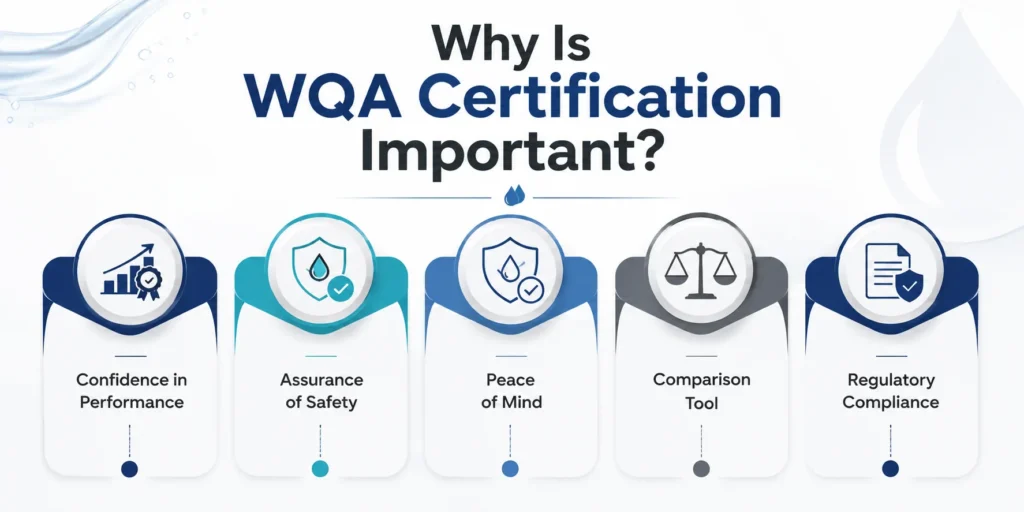
When a water treatment product bears the WQA certification, it gives you peace of mind that your water and health is in reliable hands. Here is why a WQA seal is crucial when purchasing a water purification product.
- Confidence in Performance: It validates that the product lives up to its manufacturing claims. When a filtration system says it removes 99% of lead, WQA certification proves it has been rigorously independently tested and passed the test.
- Assurance of Safety: WQA checks the product for material safety, which confirms that the product is made using quality materials and won’t leach harmful substances into your water.
- Peace of Mind: You enjoy the peace of mind that the product you are investing in is durable and won’t fail or malfunction under normal conditions.
- Comparison Tool: You can compare products from different brands fairly. If one filter carries the WQA mark for a claim, and one does not, you know which one to trust.
- Regulatory Compliance: Certain regions like California require products making health claims to be certified by an ANSI-accredited certifier such as WQA in order to be legally sold.
Note: The WQA certification doesn’t indicate a filter removes every possible contaminant. It is very specific. A filter might be certified for eliminating chlorine, which is an aesthetic issue, but not lead, which is a health concern. Make sure to check the exact claims listed on the product’s packaging and the WQA website.
What Does a Water Quality Association Gold Seal Tell?
The WQA Gold Seal is the certification’s visual representation. The seal communicates some crucial things about the product.
- That specific water treatment product has been independently tested by an accredited third-party lab, and not just the manufacturer itself, which adds an extra layer of trust and credibility to the product.
- All the materials used in manufacturing the product are completely safe and will not contaminate the water.
- The product will perform as promised. It will remove the specific impurities listed on the product’s performance data sheet and packaging. (Please remember the product won’t remove all the contaminants, but only the ones specified).
- The brand’s manufacturing facility is properly inspected every year to ensure it continues to meet the quality and durability standards.
When you spot the Gold Seal on a product, it is something you can trust, as it is an internationally recognized standard that safeguards drinking water.
Are WaterMart Water Filters WQA-Certified?
At WaterMart, we are dedicated to delivering reliable and high quality products. All our products are NSF/ANSI certified, and many carry the WQA certification against different NSF/ANSI standards.
- The Pentair water filtration system, for instance, has its filter cartridge tested and certified by WQA against NSF/ANSI standard 42 for material safety.
- Our 5-stage tankless RO system is tested and certified by WQA against NSF/ANSI standard 42 for material safety and WQA/ASPE/ANSI S-803 for sustainability.
- Our standard reverse osmosis system is also independently checked and verified by WQA against NSF/ANSI standard 42 for material safety and WQA/ASPE/ANSI S-803 for sustainability.
Committed to delivering the finest water treatment solutions to home and business owners across Canada, we make sure our products carry the essential certifications for your peace of mind.
How to Check If Your Water Filter Is WQA-Certified
Instead of taking the manufacturer’s word for it, verify your water filter’s WQA certification yourself.
- Start by checking the product’s packaging for the WQA Gold Seal. You can check the owner’s manual too.
- Check the official website of WQA: https://wqa.org/
- Next, look for the ‘Certified Products’ section, which is a public database of all the certified products.
- Search for your product there by adding the manufacturer’s name, brand name, or specific model of your water filtration unit.
- Once you locate your product, verify that the claims listed on the WQA website match the claims on the product you are thinking of buying.
Follow this simple process to shield yourself and your family against misleading marketing and to make sure you buy a safe and trustworthy product.
Frequently Asked Questions
Does WQA certification mean a filter removes all contaminants?
No. WQA certification is claim-specific. A filter may be certified to eliminate chlorine (NSF/ANSI 42) but not lead (NSF/ANSI 53). You can check the product’s packaging and performance data sheet to find out the contaminants it is certified to remove.
Does WQA certification guarantee safe drinking water?
The WQA certification verifies that a certain product will remove the specified contaminants, but it does not mean the water is clear of all contaminants. However, using a WQA-certified filter is considered a reliable way to access clean, safe drinking water.
Can WQA certification expire or be withdrawn?
Yes, the certification can expire or be withdrawn, as it is not a one-time certification. Products are subject to continuous monitoring and annual facility inspections to ensure they continue to comply with the standards. If a product is changed without re-certification or fails a retest, the certification will likely be withdrawn.
What is the difference between WQA Certified and WQA Tested?
‘WQA Tested’ is an ambiguous term that usually means the product underwent lab testing, but not necessarily by WQA or under their full certification program. However, ‘WQA Certified’ means the product has passed the comprehensive and rigorous WQA verification process.
Should you choose a WQA-Certified filter for your home?
100% yes. Getting a WQA-certified water filter is a guarantee in itself that you are investing in a safe, robust, and dependable product that delivers safe water.
Do WQA-Certified products need regular testing or evaluation?
The product’s manufacturing company must submit to annual audits and re-testing to maintain the certification for their product.
Can a water filter have more than one WQA certification?
Yes. A single water filter can be certified to multiple standards for material safety, contaminant removal, sustainability, and other performance factors.
Wrapping Up on WQA-Certified Water Filters
Planning to change your water filter or buy one the first time ever? Look for the WQA Gold Seal, and you’ll be safe. This independent, third-party verification proves that the product’s claims are real and that it has been built to a high standard.
WaterMart has quite a vast collection of advanced water treatment solutions carrying the NSF/ANSI and WQA certifications. Explore our collection and book a consultation call with our experts to find the right fit for your home.