How to Choose a Water Treatment Company in GTA?
A suitable water filter company in the GTA starts with assessing your water quality, not the system they’re trying to sell you. You’ll know you have a reliable provider when they test your water first, explain its hardness and contaminant levels, and tell you exactly what their equipment can and cannot deal with. They’ll also give you verifiable product certifications, disclose maintenance and installation prices upfront, and provide reliable after-sales support. But don’t just look at the equipment cost; check their local experience, testing processes, customer reviews, warranties, and the total estimated cost of owning their system over time.
Choosing the best water filter company can feel complicated when several companies offer similar-looking filters, softeners, and reverse osmosis systems. The equipment is only part of the decision; the company’s recommendations, installation quality, and ongoing services shape your long-term experience.
For GTA homeowners, the real starting point is what your water actually needs. A municipal supply that already meets Canadian drinking water guidelines doesn’t always require additional treatment for health reasons. Health Canada recommends contacting your local municipality for specific information about your community’s water quality before choosing a treatment device based on your individual situation.
Key Takeaways
- Choose a water filter company based on your water quality and treatment needs, not just based on the price or type of system.
- Ask for water testing or a clear explanation of the water issue before agreeing to a treatment system.
- Check product certifications and performance claims to confirm that the system is tested for the contaminants or water-quality concerns you want to address.
- Compare the full cost of ownership, including equipment, installation, filter replacements, maintenance, and warranty coverage.
- Look for a company with strong local experience, clear pricing, and reliable after-sales support so you have help after installation.
- Compare multiple water treatment companies before making a decision, especially when the recommended systems or prices differ significantly.
Do You Actually Need a Water Treatment System in the GTA?
Most households in the Greater Toronto Area are supplied by standard treated municipal water. That means a filtration system isn’t always necessary for everyone. According to Health Canada, drinking water from a community system that meets the Guidelines for Canadian Drinking Water Quality usually doesn’t need additional treatment for health-related reasons.
However, many GTA homeowners can still experience genuine reasons for additional treatment. Their water supply can have unpleasant or unwanted odors, chlorine taste, high sediment levels, or still be too hard despite fulfilling municipal standards. Some households or individuals can also choose to have highly filtered water for drinking and cooking, whether due to health reasons or a personal preference.
Remember, water quality varies across the GTA. Local water sources, treatment processes, distribution infrastructure, and household plumbing setups are different across various locations, and they all affect what reaches your taps. You can also compare water hardness levels across GTA cities before determining the best treatment for your home.
Therefore, reputable water treatment companies should clarify whether their systems address a documented water issue, an aesthetic concern, a health issue, or a personal preference. If a salesperson recommends the most expensive system without outlining what problem it solves, get a second opinion.
When comparing options, you can review WaterMart’s water filtration solutions to determine which treatment approaches best fit your needs. For drinking-water treatment, explore reverse osmosis systems or consider a combination of two water filtration setups.
What Should You Look for in a Water Filter Company?
When you’re thinking about how to choose a water filter company, keep in mind that the best choice isn’t necessarily the one with the largest product selection or lowest quoted price. Instead, it’s better to look for a company that connects your water characteristics and household requirements to a targeted treatment approach. While guiding you, they should also explain the reasoning behind their recommendation.
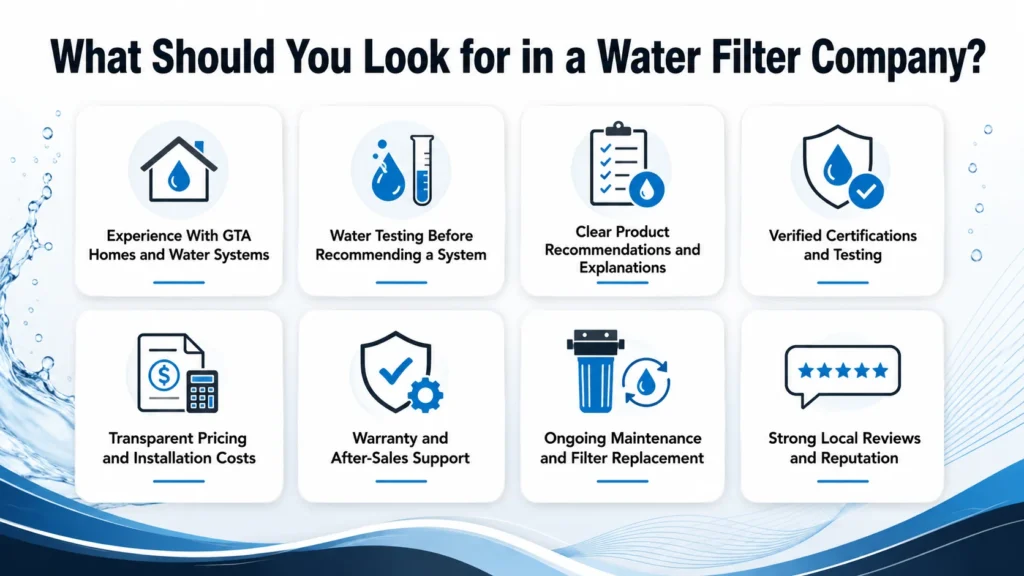
Here’s a breakdown of what to look out for when choosing your water filter provider:
Experience With GTA Homes and Water Systems
Local experience matters since GTA homes have different plumbing setups, water characteristics, water concerns, layouts, and usage patterns. A company regularly supplying the region is more likely to understand common local water concerns and how to handle them practically while installing equipment in GTA properties.
WaterMart has been serving the GTA since 1991 and provides water testing, filter installation, and maintenance services across the region along with delivering state-of-the-art water treatment systems.
Water Testing Before Recommending a System
A credible water filter company first determines the main water issues and then recommends a relevant treatment. Transparent water testing can help professionals identify factors like hardness, chlorine, iron, sediment, and contaminants that adversely affect water quality.
The purpose of this test is to determine whether water treatment is required. If the answer is yes, the test will also help determine which technology is best for resolving the original problem.
Clear Product Recommendations and Explanations
A salesperson or sales team should be able to explain why a particular system is right for your home. Ask what the technology removes, what it doesn’t remove, how much water it treats, the maintenance it requires, and how it’s suitable for your household usage.
Verified Certifications and Testing
Check for independent certification instead of just relying on a manufacturer’s statement that a product is “tested” or “high quality.”
Health Canada recommends treatment devices certified to the applicable NSF/ANSI performance standard. Relevant standards include NSF/ANSI 42 for aesthetic effects, 44 for cation-exchange water softeners, 53 for health effects, 55 for UV systems, and 58 for reverse osmosis systems.
Remember, a product’s certification should also match the claim. A system certified under one standard won’t reduce every single contaminant in your water. Overall, it’s best to verify that the certification covers the contaminants causing your main water issues.
Transparent Pricing and Installation Costs
Most water treatment companies provide a quote or estimated price, but the final cost has different components. Ask for separate information about the equipment, installation, modifications, replacement filters, maintenance, and recurring charges.
If a system seems less expensive than others, check if it comes with expensive replacement cartridges or frequent maintenance requirements. These costs add up and make the system a more expensive option in the long run.
Warranty and After-Sales Support
A water treatment system is a long-term household investment, so your relationship with the company shouldn’t end after installation. Before purchasing, check the warranty of the model, the parts and labor it covers, and the time period.
It’s also good to ask who’s responsible if there’s a leak, when the system’s performance declines, or when a replacement part is required. You want a clear service process, not just a warranty headline with limited coverage.
Ongoing Maintenance and Filter Replacement
Every water treatment technology comes with maintenance requirements. Filters and membranes have limited service lives, and the system’s treatment capacity declines as components become saturated or worn.
Before these issues occur, follow the manufacturer’s maintenance instructions and verify component longevity. Ask the company about how often you can expect cartridges, membranes, resin, or other components to require servicing and what replacement parts cost. These steps will help you get a more accurate idea of the overall costs.
Strong Local Reviews and Reputation
Reviews provide useful information about punctuality, installation quality, communication, and after-sales service for any company. Don’t just look at the review stars, but check for patterns. See if there are more positive comments and whether they’re about similar features.
Why GTA and Local Experience Matter?
A water treatment company working throughout the GTA deals with homes that have different water conditions, plumbing configurations, household sizes, and treatment goals. Local experience also helps a provider understand that a water concern in one municipality doesn’t automatically represent every home across the region.
Hardness levels vary between GTA municipalities, so a softener recommendation should be based on the actual water conditions and household requirements rather than a blanket statement that every GTA home needs one.
Local installation experience is important as well. A water treatment provider should account for available plumbing connections, equipment location, drainage, flow requirements, and access for future maintenance. A technically suitable system still needs proper sizing and installation to perform as intended.
Certifications and Product Standards: What Should You Verify?
Don’t treat a certification logo as a general guarantee. Instead, verify the specific standard and performance claim associated with the product.
For example:
- NSF/ANSI 42 covers drinking water treatment units for aesthetic effects such as chlorine, taste, and odor.
- NSF/ANSI 44 applies to cation-exchange water softeners.
- NSF/ANSI 53 covers drinking water treatment units for specified health-effect contaminants.
- NSF/ANSI 55 covers ultraviolet microbiological water treatment systems.
- NSF/ANSI 58 applies to reverse osmosis drinking water treatment systems.
Understanding what NSF certification means for water treatment systems can help you determine whether a product’s certification actually supports the performance claims being made.
Whenever possible, look for accredited third-party certification and confirm that the certified performance relates to the contaminant or water-quality concern you are trying to address.
You can also review the certification information provided by NSF to understand what different standards cover. NSF notes that certification is not a ranking system and does not mean a system reduces every possible contaminant.
What are the Biggest Red Flags?
Professional water filter companies should be upfront in explaining their recommendations and giving documentation for each product. If a sales process is reliant on vague claims, unverifiable information, and pressure to buy fast, stay alert. Here are some red flags to watch out for when you’re comparing water filter companies in the GTA:
- Recommending a System Before Understanding Your Water: Any sincere and reliable provider should pinpoint your water quality concerns and unique household requirements before recommending their equipment. When you choose WaterMart, for instance, the first step is to book a free water test before proceeding.
- Using Fear to Sell: Some companies can try to hurry a sale by making dramatic demonstrations or worrying claims about municipal water. Exaggerating the dangers of ordinary tap water without laboratory-backed evidence signals that the company is more interested in their profit than helping a client get what they need.
- Claiming You “Need” a Softener Without Explaining Why: Hard water is a genuine concern for many households in the GTA, but any water filter recommendation should relate to your specific water hardness levels and goals. Failing to investigate the actual requirements first is a warning signal, so be cautious.
- Making Unverified Contaminant-Removal Claims: If the company makes tall claims about the excellent performance of their systems, request proper certification and information about specific models. Don’t accept any broad statements about a specific filter that removes every contaminant. To put it simply, there’s no such thing.
- Refusing to Provide Product Specifications: You should be able to review all specifications for a water filter system, such as expected flow rate, maintenance requirements, dimensions, capacity, and certification before finalizing a purchase.
- Hiding Installation or Maintenance Costs: Don’t settle for a simple quote: ask each provider for the total estimated cost, including installation services, replacements, routine services, and repairs. If a company seeks to hide such costs from you, think twice before finalizing anything.
- Pushing Long-Term Rental Contracts Without Showing the Total Cost: If a company tries to push a long-term contract, especially without revealing the total cost, it’s suspicious. Compare the contract payments with the purchase price plus estimated maintenance costs to get a better idea of what’s on offer.
- Offering a Water Test Without Details: Offering a water test isn’t an issue in itself, but the problem occurs if you’re not informed about the test parameters, who is performing the test, and how the results will influence their recommendation.
- No Clear Warranty or After-Sales Support: Don’t commit to any system without clearly understanding who handles the repairs, replacement parts, and warranty claims.
How Comparing Multiple Quotes Protects Your Investment?
Getting different quotes from water treatment providers makes it easier for homeowners and managers to identify the differences in the available systems. Some companies include installation and future routine servicing in their quotes, while others only give an estimate of the equipment costs. With the full information on hand, you can avoid misleading price comparisons before making any decision.
Below is a comparison of water filter companies serving the Greater Toronto Area. The different factors determine the final and ongoing costs:
| What to Compare | WaterMart | Culligan Ontario | Kinetico GTA |
| Water Testing | Free water consultation | Free in-home water analysis | Water test available through local dealer |
| Product Certifications | NSF/ANSI 42 & 58 on listed RO systems; softener listed with NSF/ANSI 42 & 58 | Product-specific certifications | Many systems have third-party WQA certification |
| Warranty Coverage | 5 years | Varies by system | 5–10 years depending on softener model |
| After-sales Support | Installation and ongoing service available | Installation and maintenance provided | Authorized dealers provide installation, parts, and ongoing service |
| Installation Cost | Included/quote-based | Quote-based | Basic installation included with Kinetico Comfort plan |
| Equipment Cost | Quote-based | Quote-based; rental also available | Quote-based; Kinetico Comfort starts at $99/month |
| Filter Replacement Cost | Depends on system and filter type | Depends on system | Care+ plans start at $34/month for unit-only coverage |
| Maintenance Requirements | System-specific; filter replacement and servicing required | Company handles scheduled maintenance | Care+ includes annual service on eligible systems |
| Long-term Cost | Request a system-specific quote | Compare purchase/rental + service costs | Kinetico Comfort: $99/month for 15 years; Care+ starts at $34/month |
The comparison here gives Canadian homeowners an insight into different water treatment systems and helps them know which is best for their location. Before finalizing any treatment option, it’s best to know your current water quality and expected costs.
Which Water Treatment System Is Right for Your Problem?
No single water treatment system can deal with every water-quality concern. The most relevant water treatment technology for your home depends on whether the main priority is better-quality drinking water, treating hardness, improving taste and odour, or dealing with sediment. You also have to consider whether your supply calls for treatment throughout the home or only for specific faucets and locations.
Take a look at our various water treatment systems available today:
Reverse Osmosis Systems
Our reverse osmosis systems are a point-of-use treatment, often installed at the kitchen sink or any other tap where homeowners want more extensive filtration. It’s the best option for enhancing the quality of your drinking and cooking water. If your main goal is to treat water for consumption instead of softening the whole supply, compare reverse osmosis systems and choose the model that fits your requirements.
Water Softener Systems
Water softener systems are your best bet if the main concern is water hardness caused by calcium and magnesium. They use the ion exchange technology to reduce hardness, which exchanges the hard mineral ions (calciu,m and magnesium) for sodium and potassium ions.
These systems usually work on the general water supply throughout your home. You can choose different sizes for your home’s water softener depending on the level of consumption and the current hardness levels.
Whole-Home Filtration Systems
Whole-home filtration systems treat the water supply entering your property, which means that several taps get filtered water. They’re a great choice for households with water-related issues like sediment, unpleasant taste, contaminants, and chlorine.
WaterMart offers various whole-home water filtration options to deal with different water conditions. Explore the different models to work out the right media and system configuration for your needs.
Under-Sink and Point-of-Use Filters
Under-sink and other point-of-use filters treat water where it’s mostly used for cooking and drinking purposes. They’re a very practical choice when it’s not necessary to treat all the water coming into a home.
The point-of-use system also makes it relatively easier to deal with a specific water issue. You treat the water where it matters the most and benefit from the results. As long as the untreated water is suitable for showering, laundry, and cleaning, there’s no need to treat every single liter used in your home.
Frequently Asked Questions About Choosing a Water Treatment Company
What evidence shows that I need this treatment?
Signs such as scale buildup, orange staining around faucets, cloudy water, and unpleasant odors are evidence that you a need water treatment system. Ask for WaterMart’s free water test to identify specific water-quality issues and see how our technology treats them. If you’re using municipal water, review information about it, and note the concerns to look for in your supply.
What does the system remove or reduce?
When choosing a water treatment system, ask for a list of the impurities and substances that it’s supposed to treat. The response will identify specific performance points rather than making broad claims like ‘purifies everything’. Also, check the model’s certification to confirm that it supports the claims.
What does it not remove?
No single water treatment system will remove every single contaminant and impurity. Before installing any system or a combination of systems, get updates on what it will not remove. This way, you’ll know just the type of protection you have and whether additional treatment is required or not.
Why is this technology appropriate for my home?
Reach out to the WaterMart team to get details on whether a certain system is right for your water supply and household needs. Get to know your water quality, water use, and main water-related issues and how they lead to a certain recommendation.
Can you provide the product’s certification/testing documentation?
Yes, you can ask us for any product’s certification and its testing information before finalizing the purchase. Don’t just rely on certification logos, but look into what they mean and what standards your system meets.
What will I spend over the next 5–10 years?
When you’re getting a water treatment system, the purchase price is only an initial cost. Consider the installation costs, replacement filter prices, replacement membrane prices, repairs, routine maintenance, and electricity costs if applicable. Overall, the combined expenses will give you an idea of what a water treatment system costs over 5-10 years.
Final Thoughts
Choosing the best water filter company in the GTA starts with understanding your water and ends with evaluating the company behind the equipment. Look for a provider that tests or assesses your water, explains the technology clearly, provides verifiable certification information, discloses the full cost, and supports the system after installation.
At the end of the day, you don’t need the most complicated or most expensive system. Get in touch with WaterMart today to acquire a properly matched solution that addresses your water-quality goal and can be maintained for the long term.