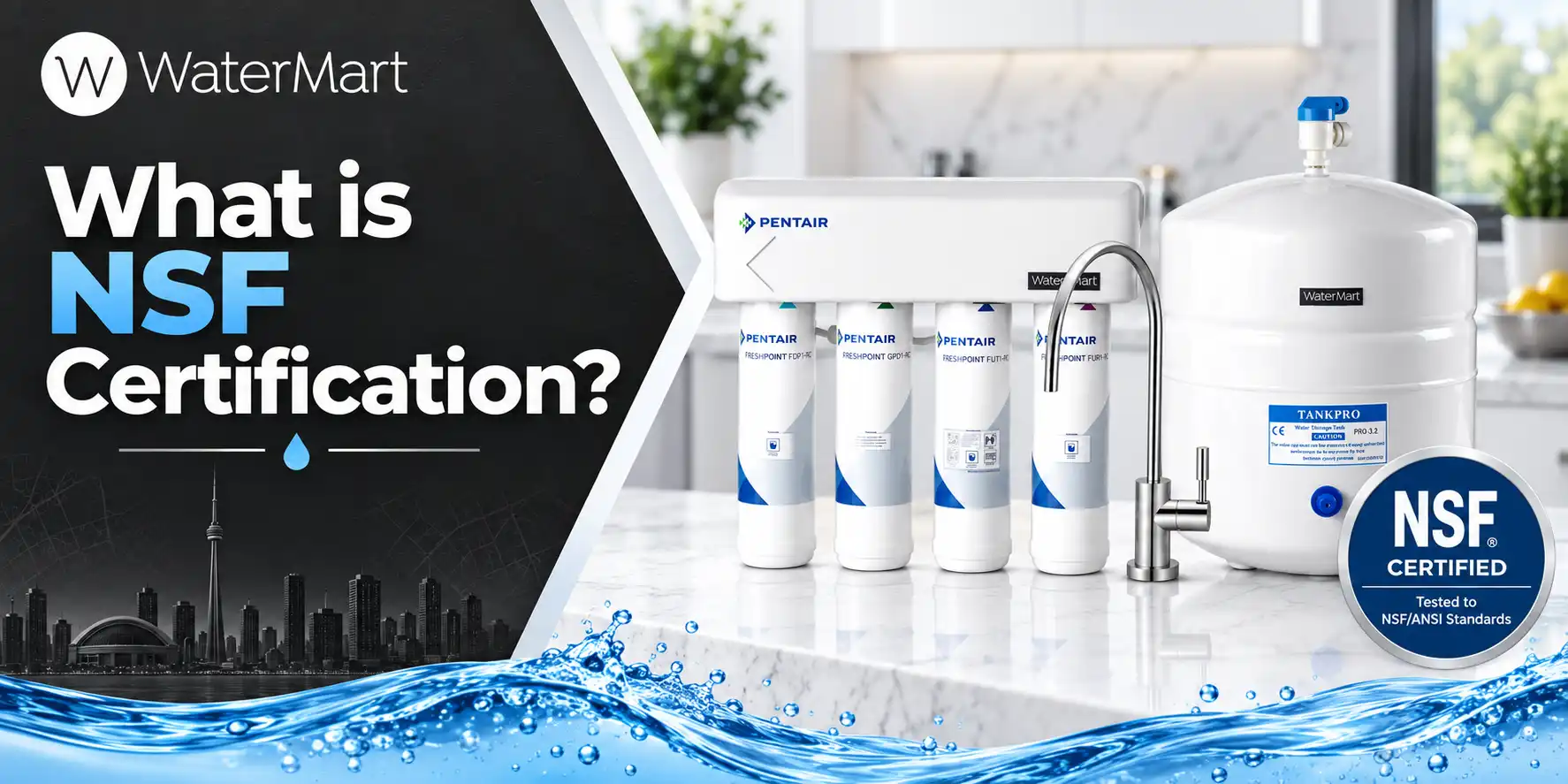
What Does NSF Certification Mean for Water Filters?
If you’ve shopped for a water filter recently, you’ve probably seen the letters “NSF” stamped somewhere on the box, often next to a number like 42, 53, or 58. For most homeowners, that’s where the understanding stops. Is NSF a government agency? A private lab? Does “NSF certified” mean the filter is safe, or just that someone tested it once?
This guide breaks down what is NSF certification, how it relates to ANSI, which standards matter for water filters, and how to tell the difference between a filter that’s genuinely certified and one that’s simply riding on the NSF name.
Key Takeaways:
- NSF International is an independent, nonprofit organization that develops public health standards and certifies products against them; it isn’t a government agency.
- “NSF/ANSI” standards are developed under a process accredited by the American National Standards Institute (ANSI), which is why the two names appear together.
- Certification is contaminant-specific: a filter certified under NSF/ANSI 42 for chlorine taste and odor is not automatically certified to remove lead, PFAS, or bacteria.
- “NSF certified” and “tested to NSF standards” are not the same claim; only the former means an accredited third party verified the product and audits the factory over time.
- The EPA regulates public tap water, and the FDA regulates bottled water; NSF certification is a separate, voluntary layer that verifies how well a specific filter performs.
What Is NSF?
NSF International was founded in 1944 as the National Sanitation Foundation, and today it develops public health standards and certification programs covering food, water, consumer products, and the environment. It is not a government body; it’s an independent, nonprofit organization that writes test protocols and runs accredited labs.
In the water filtration industry specifically, NSF plays two roles. First, it helps write the technical standards that define what a filter has to do to earn a given claim (like reducing lead, chlorine, or cysts).
Second, it operates one of the certification bodies that tests products against those standards, audits manufacturing facilities, and issues the right to display the NSF mark. When you see the NSF mark on a filter, it indicates that the specific product was independently tested and found effective for the claims listed.
It’s worth knowing that NSF isn’t the only organization allowed to certify products to these standards. The Water Quality Association (WQA) and IAPMO also certify to the same NSF/ANSI standards.
A WQA-certified filter has met the identical requirements as an NSF-certified one; the standard number is what matters, not which certifying body’s logo appears on the box.
What Is ANSI, and What Does It Have to Do with NSF?
ANSI, the American National Standards Institute, is a private and non-profit organization that guides the set of rules for products, tools, and workplace safety in the United States. It doesn’t test water filters or issue certifications itself. Instead, it accredits the process.
It ensures that the standards are developed, making sure that the process is open, balanced, and reaches genuine consensus among manufacturers, regulators, public health experts, and consumer representatives.
That’s why nearly every relevant standard is written as “NSF/ANSI” followed by a number: NSF writes the test protocols and runs the labs, while ANSI accredits those protocols as consensus national standards.
NSF and ANSI aren’t two separate certifications you need to look for; they’re two halves of the same framework. NSF is the organization doing the technical work and testing; ANSI is the body confirming that the standard itself was developed fairly.
When a filter says “NSF/ANSI 53 certified,” it means the product met a nationally recognized, ANSI-accredited standard, verified through NSF’s (or another accredited body’s) testing process.
Why Is NSF Certification Important?
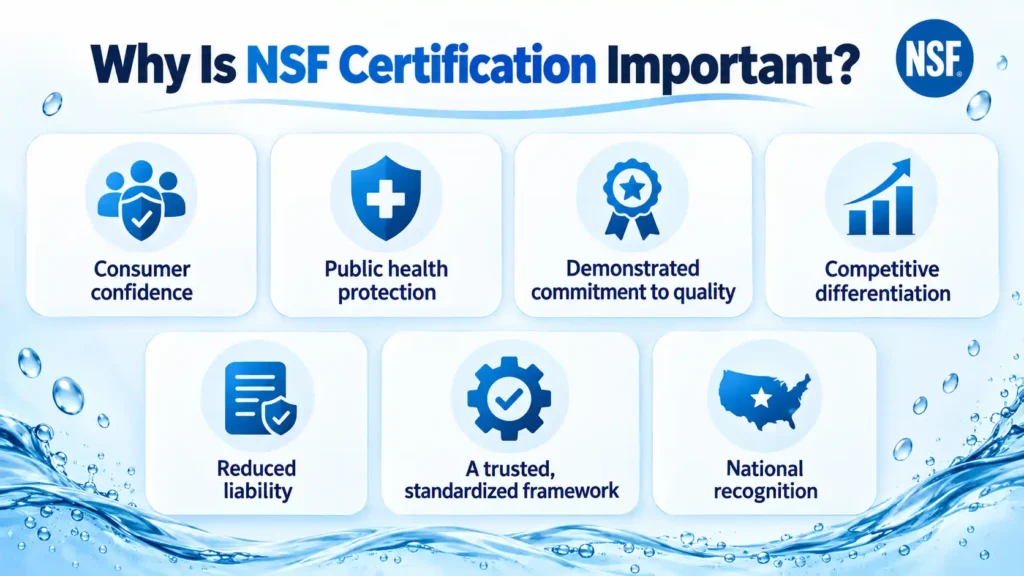
For a category as personal as drinking water, third-party verification matters more than a manufacturer’s word. NSF certification matters for several solid reasons:
- Consumer confidence: It gives buyers an independent basis for trusting a contaminant-reduction claim, rather than relying on marketing copy alone.
- Public health protection: Standards are built around real health-based thresholds for lead, VOCs, and other contaminants, not arbitrary marketing benchmarks.
- Demonstrated commitment to quality: Pursuing certification (which involves cost, testing, and ongoing audits) signals that a company is willing to be held accountable for its claims.
- Competitive differentiation: In a market full of similar-looking filters, a specific, verifiable certification separates a product from uncertified competitors.
- Reduced liability: Manufacturers that can point to independent verification are in a stronger position if a contaminant-reduction claim is ever challenged.
- A trusted, standardized framework: Because NSF/ANSI standards are consistent nationwide, a certification means the same thing whether the filter is sold in Toronto or Tampa.
- National recognition: Certification is recognized by regulators, retailers, and institutional buyers across North America, which matters for anything sold at scale.
What Does NSF Certification Actually Guarantee?
This is where a lot of confusion starts. NSF certification does not mean a filter removes “everything” or that your water is universally safe. It means something narrower and more useful: the specific product, tested under defined lab conditions, met the performance requirements for the exact contaminant claims listed on its certification.
Certification is contaminant-specific and claim-specific. A filter certified under NSF/ANSI 53 for lead reduction is certified for that claim; it isn’t automatically certified for PFAS, chromium, or cysts unless those are separately listed. Two filters can both carry an “NSF/ANSI 53” label, while one is certified for lead and the other for cysts.
Certification also doesn’t judge your specific water source; it verifies performance under controlled lab conditions, which is why matching the certification to your actual water quality concerns (ideally based on a water test) matters more than just seeing a logo on the box.
NSF vs. EPA vs. FDA: Which One Matters for Water Filters?
Consumers often assume these three are interchangeable terms. They’re not, and each has a distinct scope.
- NSF: A private, independent organization that develops testing standards and certifies specific products (including water filters) against those standards. NSF certification is voluntary; manufacturers choose to pursue it, and it applies at the product level, not the water supply level.
- EPA: The Environmental Protection Agency regulates municipal tap water under the Safe Drinking Water Act, setting enforceable limits on contaminants and overseeing how public water systems are treated, monitored, and reported on. The EPA doesn’t certify individual home water filters; it regulates the water coming out of the municipal system before it ever reaches your tap.
- FDA: The Food and Drug Administration regulates bottled water as a packaged food product rather than a home filtration device, since bottled water is treated legally as a food item. By law, the FDA’s bottled water standards must be at least as protective as the EPA’s tap water standards, and in some cases (such as lead limits) they’ arere stricter.
In short,: EPA and FDA govern the water itself (tap and bottled, respectively), while NSF certification is the independent check on whether a specific filtration product actually does what it claims to do.
NSF Certified vs. NSF Tested: What’s the Difference?
This distinction is one of the most commonly exploited by marketing copy. “NSF certified” and “tested to NSF standards” sound almost identical, but they mean very different things.
NSF certified means an accredited third-party body, ‘NSF’, has tested the actual product, verified its performance claims, and conducts ongoing factory audits and retesting to confirm the product continues to meet the standard over time.
“Tested to NSF standards” or “NSF-grade” is a much weaker claim. It often means a manufacturer ran its own internal test using part or all of an NSF test method, without ever submitting the product for independent certification or ongoing surveillance.
Industry guidance is consistent on this point: phrases like this are not equivalent to certification and may not reflect any genuine third-party verification.
The practical takeaway: don’t take marketing language at face value. If a product page says “tested to NSF standards” rather than “NSF certified,” treat it as an unverified claim rather than proof of independent testing.
Which NSF Standards Apply to Water Filters?
Different standards cover different water concerns. Here are the ones most relevant to residential water filters:
| Standard | What It Covers |
| NSF/ANSI 42 | This is an official American National Standard that normally covers aesthetic effects rather than covering all contaminants present in water. It caters to the reduction of chlorine, taste, and odor without addressing health-related contaminants. |
| NSF/ANSI 53 | It is an official public health standard for water filters capable of removing health-hazardous contaminants from drinking water. It sets rules for water filters to withstand high pressure; reduction of contaminants like lead, mercury, VOCs, asbestos, and (for some products) microbial cysts such as Cryptosporidium and Giardia. |
| NSF/ANSI 55 | It covers uUltraviolet point-of-entry and point-of-use microbiological water treatment systems. The NSF/ANSI 55 standard defines the safety rules for design and performance, distinguishing between UV classes and the source water conditions they’re intended for. |
| NSF/ANSI 58 | This is an official safety standard that certifies point-of-use reverse osmosis (RO) systems, verifies TDS reduction performance, materials, structural integrity, and system efficiency. |
| NSF 401 | This international standard tests and certifies water filters for their ability to remove 15 emerging or incidental contaminants not covered by standards 42, 53, or 58, including certain pharmaceuticals, herbicides, plasticizers, and pesticides at trace levels. |
The number itself isn’t a ranking system. NSF/ANSI 53 isn’t “better” than NSF/ANSI 42; they test entirely different things. A filter that only carries NSF/ANSI 42 will make your water taste and smell better, but says nothing about lead or VOC reduction.
If your priority is health-related contaminants, look specifically for NSF/ANSI 53, 58, or 401 listings, and check that the exact contaminant you’re concerned about is named on the certification, not just implied by the standard number.
Do Water Filter Companies Have to Maintain Certification?
Yes. NSF certification isn’t a one-time badge a manufacturer earns and keeps forever. Certified companies are subject to ongoing plant audits, periodic retesting of production samples, and material and construction reviews to confirm the certified product hasn’t changed in ways that would affect its performance.
If a manufacturer alters a filter’s media, materials, or design, it generally has to be retested before the certification carries over to the new version. This is part of what separates “certified” from “tested once and marketed forever.”
Are WaterMart Water Filters NSF Certified?
The honest answer is: it depends on the specific system, and going through WaterMart’s product pages can help you decide why reading the fine print matters.
- The Standard Reverse Osmosis System and the Pentair Multi-Stage Filtration System both come with NSF-related certifications. Also, the filter cartridges are tested and certified against NSF/ANSI Standard 42 for material safety requirements, meaning the certification confirms the materials in contact with your water won’t leach anything harmful, not that the cartridge is independently verified to reduce a specific list of contaminants. The Pentair system is also NSF/ANSI 53 and 58 certified, so it’s worth considering that you are buying what’s been tested by international standards.
- Our Standard Filtration System is also “NSF Certified” and “certified by the National Sanitation Foundation,” meaning you are buying a safe and healthy water filtration system for your family.
- The Countertop Reverse Osmosis Systems are CSA (a safety certification for electrical appliances) and RoHS (restriction of hazardous substances in materials), which address electrical safety and material composition.
How Does a Water Filter Get NSF Certified?
Getting certified is a multi-step process, not a form a manufacturer fills out:
- Application and product review: The manufacturer submits the product and identifies which standard(s) and contaminant claims it wants certified against.
- Material safety testing: Components that contact drinking water are tested to confirm they don’t leach harmful substances into the water.
- Performance testing: The filter is run under standardized lab conditions using water spiked with the specific contaminants it claims to reduce, to confirm it meets the required reduction thresholds.
- Structural and integrity testing: The unit is tested to confirm it holds up under normal residential water pressure and doesn’t fail or leak over time.
- Facility audit: NSF (or the certifying body) audits the manufacturing plant to confirm that quality control processes match what was tested.
- Ongoing surveillance: Once certified, the manufacturer is subject to periodic retesting and unannounced audits to confirm the certified product continues to perform as tested.
Only after clearing all of these steps can a manufacturer legally use the NSF mark for that specific product and claim.
Frequently Asked Questions
Can you trust non-NSF filters?
A filter without NSF certification isn’t automatically unsafe, but you’re relying entirely on the manufacturer’s own claims with no independent verification. If a specific health contaminant matters to you (lead, PFAS, VOCs), an uncertified product gives you no third-party confirmation that it actually reduces it.
Are NSF-certified products worth the money?
For contaminants that affect health, yes, the independent verification is the point of paying for certification. For purely aesthetic concerns (taste and odor only), the value of certification is smaller, though it still confirms that the manufacturer’s claims are accurate.
How can you verify an NSF-certified water filter?
Search the product name or model number in NSF’s public certified product listings, which show the exact standard and contaminant claims for that model. Don’t rely solely on marketing language on the packaging or product page.
Are NSF-certified water filters safer?
They’re independently verified to perform as claimed for the specific contaminants listed, which is different from being “safer” in some general sense. Match the certification to the contaminants actually present in your water for it to be meaningful.
Is an NSF-certified water filter worth the extra cost?
Often yes, particularly for reverse osmosis systems or health-contaminant claims, since the certification process adds real cost to manufacturing and ongoing compliance, costs that uncertified competitors don’t carry.
Does every water filter from an NSF-certified company have NSF certification? No. Certification applies to specific products and specific claims, not to a company as a whole. A manufacturer can have some certified models and some uncertified ones in its lineup at the same time.
Wrapping Up
NSF certification is one of the few reliable, independent signals in a saturated water filtration market, but only when you read beyond the logo. The standard number and the specific contaminant claim matter more than the presence of “NSF” on the box.
Before buying a filter, check whether the certification covers material safety only or full contaminant-reduction performance, confirm the claim against NSF’s public database, and match it to whatever’s actually showing up in your water. That’s the difference between a filter that’s genuinely verified and one that just looks like it is. And for that, get a professional water test first if you haven’t already.