Water Hardness Level by City in Ontario | GTA Guide
The Greater Toronto Area (GTA) has some of the hardest municipal water supplies in Canada. Residents in this area may notice the adverse effects of this problem, but most of them may not even know the exact hardness levels of the water supply they get in their homes. Appliance wear, scale buildup, and a problematic taste in your water are just a few reasons why it’s important to know about hardness levels and their solutions.
The water across most GTA cities ranges from soft to very hard , with an average of about 120-250 mg/L. The primary cause of GTA water hardness is the presence of Lake Ontario’s limestone runoff and groundwater aquifers. For most homeowners within this region, it means that additional water treatment can protect their plumbing and appliances while enhancing overall water quality.
Key Takeaways
- The water supply in most GTA cities ranges from hard to very hard, with the levels ranging from 120-250 mg/L depending on the water source and city.
- Lakefront municipalities such as Toronto and Pickering usually have lower water hardness levels than groundwater-fed inland municipalities like Brampton and Caledon.
- Naturally occurring minerals like magnesium and calcium cause hardness in water. In Ontario, these minerals are absorbed by the water moving through limestone-rich bedrocks and groundwater aquifers.
- Hard water causes issues like scale buildup in appliances and plumbing systems, dry skin, dry hair, and a flat or metallic taste in drinking water.
- When the water supply measures above 180 mg/L, it falls in the Very Hard category, which usually calls for a whole-home water softener system to protect appliances and pipes plus prevent health issues.
- A professional water test is the best way to assess the required water treatment for a specific property. The hardness levels can vary according to many factors, so a water test determines whether you need an RO system, carbon filtration, or a whole-home water softener.
How to Interpret the Water Hardness Scale
Water hardness is measured in milligrams per liter of calcium carbonate (mg/L) as grains per gallon (GPG). For reference, 1 GPG is equal to around 17.1 mg/L. The table below will further show how to interpret these numbers and determine how they affect your home: your home:
HARDNESS CLASSIFICATION TABLE:
| Classification | mg/L (CaCO₂) | GPG | What It Means for Your Home |
|---|---|---|---|
| Soft | 0–60 | 0–3.5 | No scaling. No treatment needed. Appliances run at full efficiency. |
| Moderately Hard | 61–120 | 3.5–7 | Minor scaling possible on fixtures. Treatment is optional but beneficial. |
| Hard | 121–180 | 7–10.5 | Noticeable scale on appliances and pipes. Water softener recommended. |
| Very Hard | 180+ | 10.5+ | Significant scale buildup. Reduced appliance lifespan. Softener strongly advised. |
Water Hardness by City in the GTA
The table below gives you a color-coded glance at the water hardness levels in Ontario cities. It displays figures sourced from annual municipal water quality reports and regional water authority publications in the GTA.
Keep in mind that the published water hardness levels are usually annual averages and can vary according to season, neighborhoods, infrastructure age, and local distribution zones. Consult your municipal water authority directly for the most recent figures in your area.
COLOUR KEY: Orange = Hard | Red = Very Hard | Yellow = Moderately Hard
| City | mg/L | GPG | Classification | Water Source | Treatment Notes | Practical Impact | Source |
|---|---|---|---|---|---|---|---|
| Toronto | 120–140 | 7–8 | Hard | Lake Ontario (R.C. Harris & F.J. Horgan WTPs) | Chlorination, fluoridation, pH adjustment, corrosion control | Scale in kettles and water heaters. Softener beneficial for appliance life. | City of Toronto — Annual Drinking Water Report 2024 |
| Mississauga | 130–150 | 7–9 | Hard | Lake Ontario (Lakeview & Lorne Park WTPs via Peel Region) | Chlorination, fluoridation, pH adjustment | Slightly harder than Toronto. Common softener installations for dishwashers and appliances. | Region of Peel — Drinking Water Quality Report |
| Brampton | 200–250 | 12–15 | Very Hard | Lake Ontario via Peel Region water system | Chlorination, lime softening partial, pH adjustment | One of the hardest in the GTA. Significant scale on equipment. Softener considered standard. | Region of Peel — Drinking Water Quality Report |
| Vaughan | 180–220 | 10–13 | Very Hard | Lake Ontario via York Region (80%) and groundwater wells (20%) | Chlorination, fluoridation, pH control | Very hard. Water heaters and appliances lose efficiency faster without treatment. | York Region — Drinking Water Quality & Monitoring |
| Markham | 150–200 | 9–12 | Hard | Lake Ontario via York Region supply network | Chlorination, fluoridation, corrosion inhibitors | Hard enough to justify a whole-home softener. Scale common on fixtures and appliances. | York Region — Drinking Water Quality & Monitoring |
| Richmond Hill | 150–190 | 9–11 | Hard | Lake Ontario via York Region (primary) and groundwater | Chlorination, pH adjustment, fluoridation | Similar to Markham. Softener recommended, especially for homes with older plumbing. | York Region — Drinking Water Quality & Monitoring |
| Newmarket | 160–200 | 9–12 | Hard | Lake Ontario via York Region and Lake Simcoe (blended) | Chlorination, fluoridation, pH adjustment | Blended supply results in consistently hard water. Scale on showerheads and taps is common. | York Region — Drinking Water Quality & Monitoring |
| Aurora | 150–190 | 9–11 | Hard | Lake Ontario via York Region supply network | Chlorination, pH control, corrosion inhibitors | Hard water common across Aurora. Appliance protection is the primary reason residents install softeners. | York Region — Drinking Water Quality & Monitoring |
| King City | 170–210 | 10–12 | Very Hard | Groundwater wells (primary) with York Region supply | Chlorination, pH adjustment | Groundwater source makes this one of the harder supplies in York Region. Softener strongly recommended. | York Region — Drinking Water Quality & Monitoring |
| Stouffville | 160–200 | 9–12 | Hard | Lake Ontario via York Region (blended with local groundwater) | Chlorination, fluoridation | Hard water with groundwater influence. Noticeable scale on fixtures. Softener recommended. | York Region — Drinking Water Quality & Monitoring |
| Georgina | 170–220 | 10–13 | Very Hard | Lake Simcoe and groundwater wells | Chlorination, pH adjustment | Lake Simcoe and groundwater blend results in very hard water. Scale issues common in older homes. | York Region — Drinking Water Quality & Monitoring |
| Oakville | 120–140 | 7–8 | Hard | Lake Ontario (Halton Region WTP) | Chlorination, fluoridation, pH adjustment, corrosion control | Moderately hard for the GTA. Many newer homes still install softeners for appliance longevity. | Halton Region — Water Quality Report |
| Burlington | 130–150 | 7–9 | Hard | Lake Ontario (Halton Region WTP) | Chlorination, fluoridation, pH adjustment | Similar to Oakville. Scale forms on appliances over time. Softener is beneficial. | Halton Region — Water Quality Report |
| Milton | 140–170 | 8–10 | Hard | Lake Ontario via Halton Region (blended with groundwater in some areas) | Chlorination, pH adjustment, fluoridation | Newer areas draw from Lake Ontario; older areas may have harder groundwater supply. | Halton Region — Water Quality Report |
| Halton Hills | 150–190 | 9–11 | Hard | Groundwater wells (primary) with Halton Region treated supply | Chlorination, pH adjustment | Groundwater-heavy supply means consistently hard water. Softener commonly installed. | Halton Region — Water Quality Report |
| Caledon | 180–230 | 10–13 | Very Hard | Groundwater wells (primary) with partial Peel Region supply | Chlorination, pH adjustment | Heavily groundwater-dependent. Among the harder supplies in the GTA region. Softener strongly recommended. | Region of Peel — Drinking Water Quality Report |
| Pickering | 130–160 | 7–9 | Hard | Lake Ontario (Durham Region WTP) | Chlorination, fluoridation, corrosion inhibitors | Hard water typical of Durham Region Lake Ontario supply. Appliance scale is the main concern. | Durham Region — Water Quality Reports |
| Ajax | 130–160 | 7–9 | Hard | Lake Ontario (Durham Region WTP) | Chlorination, fluoridation, pH adjustment | Shared supply with Pickering. Consistent hardness. Softener useful for water heater and appliance protection. | Durham Region — Water Quality Reports |
| Whitby | 130–160 | 7–9 | Hard | Lake Ontario (Durham Region WTP) | Chlorination, fluoridation, corrosion control | Same Lake Ontario supply as Ajax and Pickering. Hard water consistent across Durham Region. | Durham Region — Water Quality Reports |
| Oshawa | 140–170 | 8–10 | Hard | Lake Ontario (Durham Region WTP, Oshawa zone) | Chlorination, fluoridation, pH adjustment | Slightly harder than western Durham cities. Scale on water heaters and showerheads is common. | Durham Region — Water Quality Reports |
| Scarborough | 120–140 | 7–8 | Hard | Lake Ontario (R.C. Harris WTP — Toronto Water) | Chlorination, fluoridation, pH adjustment | Served by Toronto Water. Water quality and hardness consistent with City of Toronto averages. | City of Toronto — Annual Drinking Water Report 2024 |
| Etobicoke | 120–140 | 7–8 | Hard | Lake Ontario (F.J. Horgan & R.C. Harris WTPs — Toronto Water) | Chlorination, fluoridation, corrosion control | Toronto Water supply. Hardness consistent with city average. Older homes may have legacy pipe concerns. | City of Toronto — Annual Drinking Water Report 2024 |
| North York | 120–140 | 7–8 | Hard | Lake Ontario (Toronto Water distribution network) | Chlorination, fluoridation, pH adjustment | Toronto Water supply. Same hardness profile as central Toronto. Softener optional but beneficial. | City of Toronto — Annual Drinking Water Report 2024 |
| East York | 120–140 | 7–8 | Hard | Lake Ontario (R.C. Harris WTP — Toronto Water) | Chlorination, fluoridation, corrosion inhibitors | Consistent with Toronto Water supply area. Hardness in the lower end of the hard band. | City of Toronto — Annual Drinking Water Report 2024 |
| Hamilton | 140–160 | 8–9 | Hard | Lake Ontario (Hamilton Water WTP) | Chlorination, fluoridation, pH adjustment, softening | Consistently hard. Scale buildup in plumbing and fixtures is one of the most common homeowner issues. | City of Hamilton — Water Quality Annual Report |
Data note: Hardness levels shown are typical annual averages sourced from municipal water quality reports and regional water authority publications. Figures represent mg/L of calcium carbonate (CaCO₂). Levels may vary by distribution zone, season, and pipe infrastructure. Confirm current figures with your local water authority.
Why Is GTA Water So Hard?
GTA water hardness is mostly due to its source and what it travels through before treatment at the municipal plants. Some systems are lake-fed, while others are groundwater-fed; the difference between them explains why some cities have constantly hard water while others range from soft to hard.
Let’s have a look at these two factors in detail:
Lake Ontario and Limestone Runoff
Lake Ontario is among the main sources of drinking water in Toronto, Oakville, Mississauga, Oshawa, most of the Durham region, and other lakefront municipalities. Before its water reaches the municipal treatment plants, it moves through bedrock and watersheds rich in limestone, calcium, and magnesium carbonate. The water naturally absorbs these minerals, resulting in hardness levels.
Cities that directly source their water from Lake Ontario may expect this baseline mineral load even after municipal treatment. The treatment plants may remove some of the contaminants, but many hardness minerals remain. Some other lakefront regions include Etobicoke, North York, and Scarborough.
Groundwater and Aquifers in Outer GTA Cities
Cities such as Brampton, Vaughan, Caledon, King City, and Stouffville are further away from Lake Ontario. As a result, their municipal water supply is sourced mostly from underground aquifers and groundwater wells.
Groundwater moves slowly through layers of dolomite rock and limestone, gaining magnesium and calcium deposits over time before it reaches the municipal systems.
With this extended mineral contact, it’s no surprise that the water hardness levels in outer-ring GTA municipalities record higher water hardness levels than lakefront regions. Most of the groundwater-dependent areas have water hardness levels above 180 mg/L, which is in the very hard classification.
At present, Brampton and Vaughan are consistent names among the cities with the highest hard water levels in the Greater Toronto Area. Other outer-ring regions include Richmond Hill, Markham, and Whitby.
What Hard Water Does to Your Home
The effects of hard water are grim, but since they are slow, they go unnoticed until the damage is already done. Many homeowners don’t notice anything amiss until the appliances start breaking down too easily or there’s visible buildup on the fixtures.
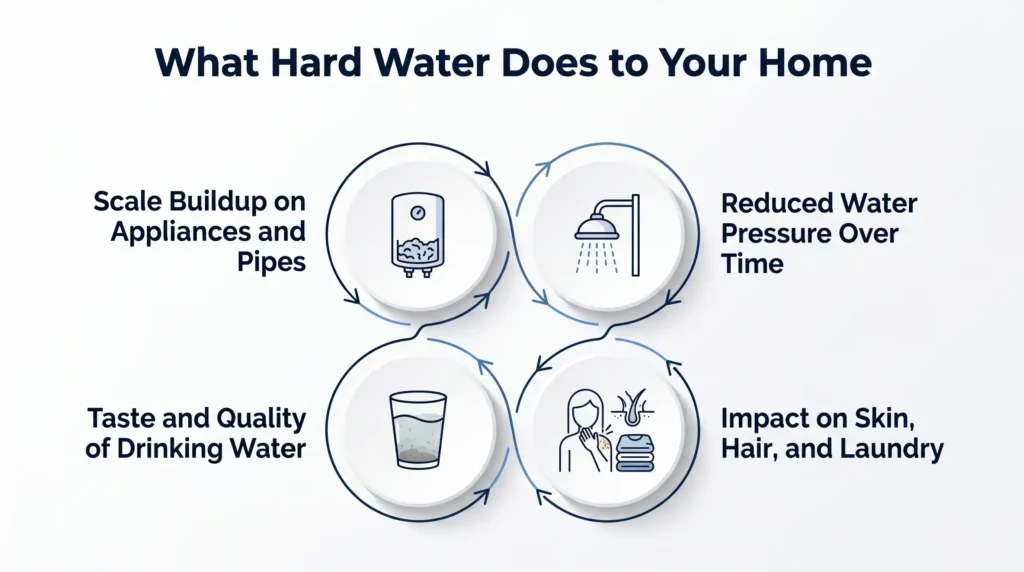
Let’s have a closer look at these main issues now:
Scale Buildup on Appliances and Pipes
Over time, any water-reliant appliance will build up calcium and magnesium deposits from the hard water supply. Some examples of such appliances include kettles, coffee makers, water heaters, dishwashers, washing machines, and espresso machines. After some months or years, you’ll notice a scale buildup on the heating elements and interiors of such appliances.
The scale is not just unsightly but also acts as an insulator and significantly reduces efficiency for many appliances. Findings from research conducted by the Battelle Memorial Institute discovered that hard water scale causes tankless water heaters to become 30% more costly to operate and completely fail after just 1.6 years of usage. Electric water heaters accumulate scale at 100 times the rate of those on softened water, and showerheads lose 75% of their flow rate in under 18 months.
Reduced Water Pressure Over Time
Hard water scale also collects inside the plumbing lines, gradually narrowing their interior diameter. Over time, these deposits restrict the water flow in your home. If you have an older property, it may have galvanized steel or copper pipes. These are especially vulnerable to hard water scale buildup, since their surfaces are rougher and allow it to attach more easily.
The Springer peer-reviewed study confirms that hard water scale buildup inside pipes causes pressure loss to sharply increase, reaching 4 times the original pressure drop after just 2 weeks of operation with hard water. The study tested extremely hard water (542–551 mg/L) under controlled conditions.
Unfortunately, it’s complicated and expensive to remedy the scale build-ups: your best bet is to opt for a water softener or water filter system as a preventative step. Installing a water treatment setup is more cost-effective and less invasive than replacing your damaged pipes in the future.
Impact on Skin, Hair, and Laundry
Hard water has minerals that interfere with the effects of soap and shampoo. As a result, homeowners with a hard water supply have to use more shampoo, soap, and detergent for effective cleaning. Even after bathing or showering, some minerals are left on your skin or hair, which explains why your skin feels dry and/or irritated, and your hair looks dull. Your laundry is also affected by hard water. After washing, your clothes will feel stiffer due to the mineral residue. The colors of your fabrics will also fade more quickly due to reduced detergent performance in hard water.
Taste and Quality of Drinking Water
Many GTA residents report that their tap water tastes flat, chalky, or a little metallic. This issue is due to the chlorine used in municipal disinfection practices, which also interacts with the minerals in the water. The altered taste of the water also affects the taste of coffee, tea, food, and beverages, though it’s still safe to drink.
This noticeable effect of hard water is one of the primary reasons why Ontario residents install water filtration systems. Very moderately hard water can adversely affect the taste of homemade food, ice, and drinks.
How Do You Know If You Have Hard Water?
Your city’s data is in the table above, but it’s best to get information about your home before taking action. If you can’t get a water quality report right away, it’s still possible to determine your property’s water hardness level. Look at the gable below to know the signs of hard water adversely affecting a home:
SIGNS OF HARD WATER:
| Sign | Where You Notice It | What It Indicates |
|---|---|---|
| White crusty buildup around taps and showerheads | Faucets, showerheads, kettle spout | Calcium and magnesium deposits — classic hard water scale |
| Cloudy or filmy residue on glassware after washing | Dishwasher output, hand-washed glasses, | Mineral residue left behind as water evaporates |
| Soap that won’t lather properly | Shower, sink, laundry | Hard water ions prevent soap from forming suds |
| Dry skin and hair after showering | Bathroom | Minerals strip moisture and interfere with skin’s natural oils |
| Flat or bitter taste in coffee or tea | Kitchen | Chlorine and minerals suppressing flavour compounds |
| Water heater or appliances losing efficiency | Kitchen, utility room | Scale coating heating elements, forcing them to work harder |
| Reduced water pressure over time | Throughout the home | Scale accumulation narrowing pipe interiors |
Why You Must Get A Professional Water Test
A self-diagnosis of your water hardness may help to an extent, but you won’t know the exact hardness level, and you’ll only be relying on guesswork. Municipal reports give you system-wide averages, but the exact hardness levels depend on your location and pipe systems. A professional water test, on the other hand, will accurately determine your home’s water hardness level.
With a professional test, homeowners get precise measurements for their water hardness. You’ll know the level of chlorine, dissolved solids, and various contaminants that determine which water treatment is best suited to your needs.
WaterMmart’s free water test and treatment guidance is always available for Ontario homeowners, so contact us today to schedule your water assessment and get a certified answer to whether or not you get hard water.
What to Do About Hard Water in Your GTA Home
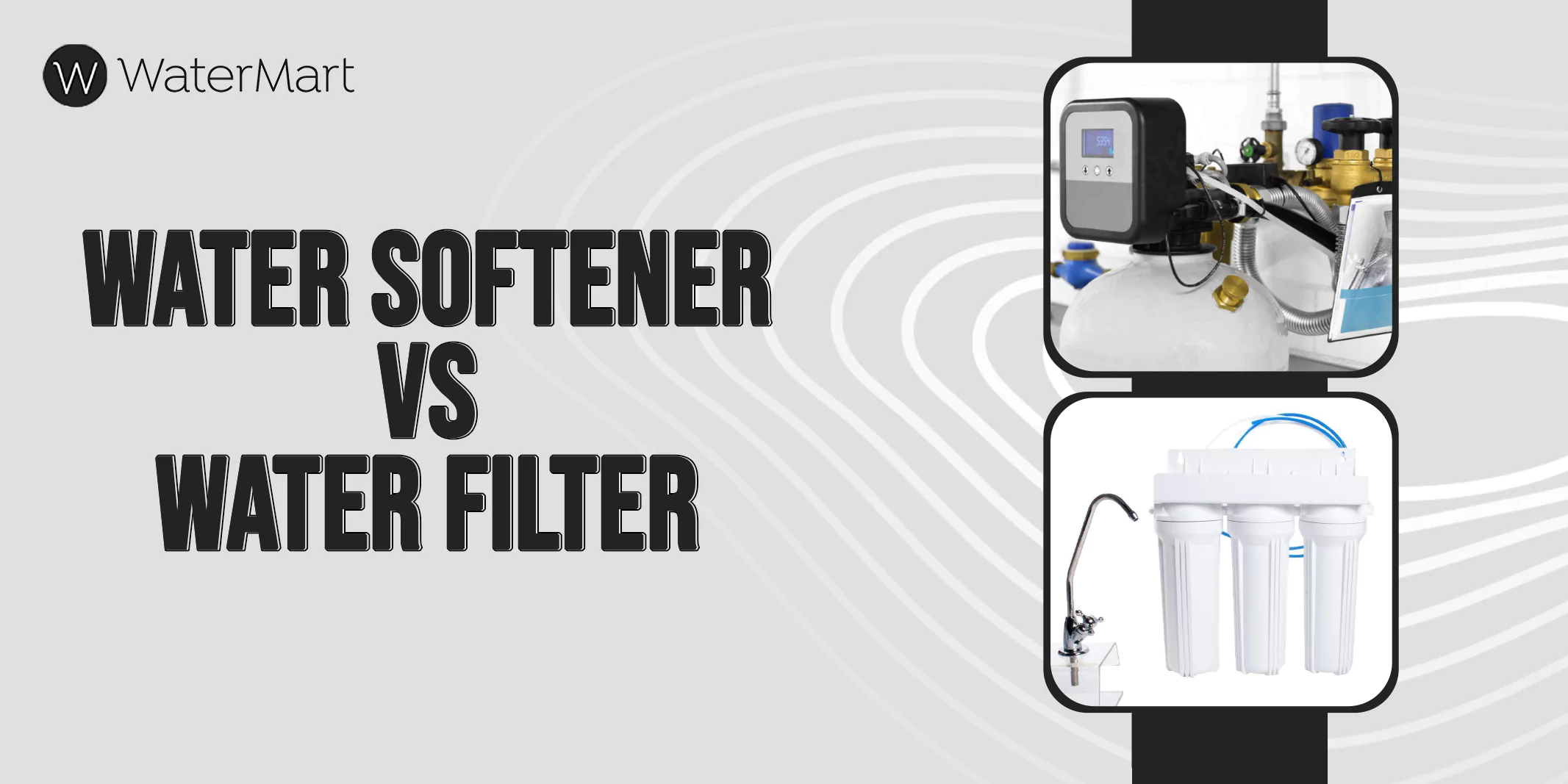
Most homeowners struggling with hard water in GTA resort to one or a combination of these three solutions: water softeners, reverse osmosis (RO) drinking water systems, or whole-home filtration systems.
Let’s walk you through these solutions.
Water Softeners
A whole-home water softener system is the most effective option for homes with very hard water (above 180 mg/L). The ion exchange technology in these setups replaces the magnesium and calcium ions with sodium or potassium instead.
Water softeners turn hard water into soft water, eliminating the issue of scale for your whole home. Softened water will feels better on your skin and hair, while also keeping appliances and fixtures free from scale.
In cities such as Brampton and Celdon, a softener system is usually an upgrade for appliance protection and not a luxury.
Reverse Osmosis (RO) Drinking Water Systems
If your main goal is better-tasting water, an under-counter RO system is the best targeted solution.
In RO systems, water is forced through a semi-permeable membrane (0.0001 micron size) that removes 90% to 99% of contaminants, including chlorine, heavy metals, PFAs (Per- and polyfluoroalkyl substances), and hardness minerals to give you great-tasting water at the tap.
You can also pair an RO system with a whole-home water softener for a comprehensive solution.
Whole-Home Water Filtration
Does your water fall in the hard range (around 120-180 mg/L), the scale buildup is manageable, but water taste usually remains an issue?. A suitable entry-level solution in such cases is a whole-home carbon filtration system. These systems improve overall water quality instead of just removing the hardness minerals. They reduce the presence of odors, organic compounds, chlorine, and sediment for every tap in the house.
While carbon filtration won’t eliminate magnesium and calcium deposits like a water softener, it will improve water taste and reduce chemical residuals. If your city is in a lower hard range, such as Oakville, Ajax, Toronto or Pickering, whole-home filtration is an effective middle-ground option.
You can find all these systems at WaterMart, including a decent range of advanced reverse osmosis systems designed for GTA and Ontario water conditions.
Frequently Asked Questions About Water Hardness in Ontario
Is Toronto water hard?
Yes, Toronto’s municipal water measures around 120–140 mg/L, or 7–8 GPG. This measurement puts it in the hard category. The water itself is sourced from Lake Ontario and treated at the F.J. Horgan and R. C. Harris plants. The hardness isn’t as high as in places like Vaughan or Brampton, but Toronto homeowners may expect scale buildup on their fixtures and appliances over time (without additional treatment).
What city in Ontario has the hardest water?
Brampton has the highest water hardness among the Greater Toronto Area cities, with levels averaging around 200–250 mg/L or 12–15 GPG. King City, Celadon, and Vaughan also fall in the very hard water category. Apart from the GTA, the hardest municipal water is found in Waterloo and Kitchener, with levels sometimes exceeding 300 mg/L.
Do I need a water softener in the GTA?
A water softener might be a good idea depending on your specific city and priorities. If your city’s municipal water falls in the hard classification (above 120 mg/L), it will cause scale buildup on fixtures and appliances. If the water hardness is above 180 mg/L, as in Georgina, Caledon, Brampton, and Vaughan, there’s a strong case in favor of water softening systems. A professional water test will further clarify the reasons for getting this additional treatment.
Is hard water safe to drink in Ontario?
According to the health standards of Health Canada and Ontario, the hard municipal water in this province is considered safe to drink. Magnesium and calcium are naturally occurring minerals, so they’re considered safe at the levels in the GTA’s municipal systems. Hard water is more of a practical issue in Ontario: it causes scale buildup, wears out appliances more quickly, and doesn’t taste very pleasant either.
What is the difference between water hardness and water quality?
Water hardness refers to the presence of minerals like calcium and magnesium, while water quality is a broader term covering the pH level, contaminants, bacteria, and chlorine presence in your water supply. Hard water can still be safe for human consumption and considered high-quality according to public health standards, as is the case in most GTA municipalities.
How do I find my city’s exact water hardness level?
Each Ontario municipality publishes an annual drinking water quality report: the relevant reports are mentioned in the data table above. Professional water tests are the most accurate way to determine water hardness levels for specific properties. The municipal figures are average, which means that hardness may vary according to neighborhood, the age of your pipe systems, infrastructure, and seasonal conditions.
Know Your Water. Protect Your Home.
Water hardness levels differ across the GTA, more than most homeowners may realize. Your friend’s home 30 minutes away may have very different water hardness issues than your own place. Similarly, a lakefront property in Toronto and a groundwater-fed house in Caledon will have very different levels of appliance wear, scale buildup, and water quality.
Knowing your city and property’s water hardness levels is the first step. From there, you can make more informed decisions about water treatment, filtration systems, and long-term maintenance. Different conditions require targeted solutions, so a homeowner may manage their hard water with a single RO system or a whole-home water softening setup.