Magnetic Water Softener | Definition, How it works, Types, Installation
Magnetic water softeners often appear as a low-cost answer for Canadian homeowners dealing with hard water problems like limescale on faucets, clogged showerheads, and reduced appliance lifespan. They are promoted as a simple clip-on device that uses magnets to change how calcium behaves in your water and “solves” scale. It sounds practical, but it doesn’t actually soften water, and you don’t get the same results as salt-based water softener systems.
But the question arises, what a magnetic water softener is and how it is different from other types of softeners. Here’s the complete breakdown of the magnetic water softener working principle, where claims fall apart, and what homeowners should realistically expect before buying.
What Are Magnetic Water Softeners?
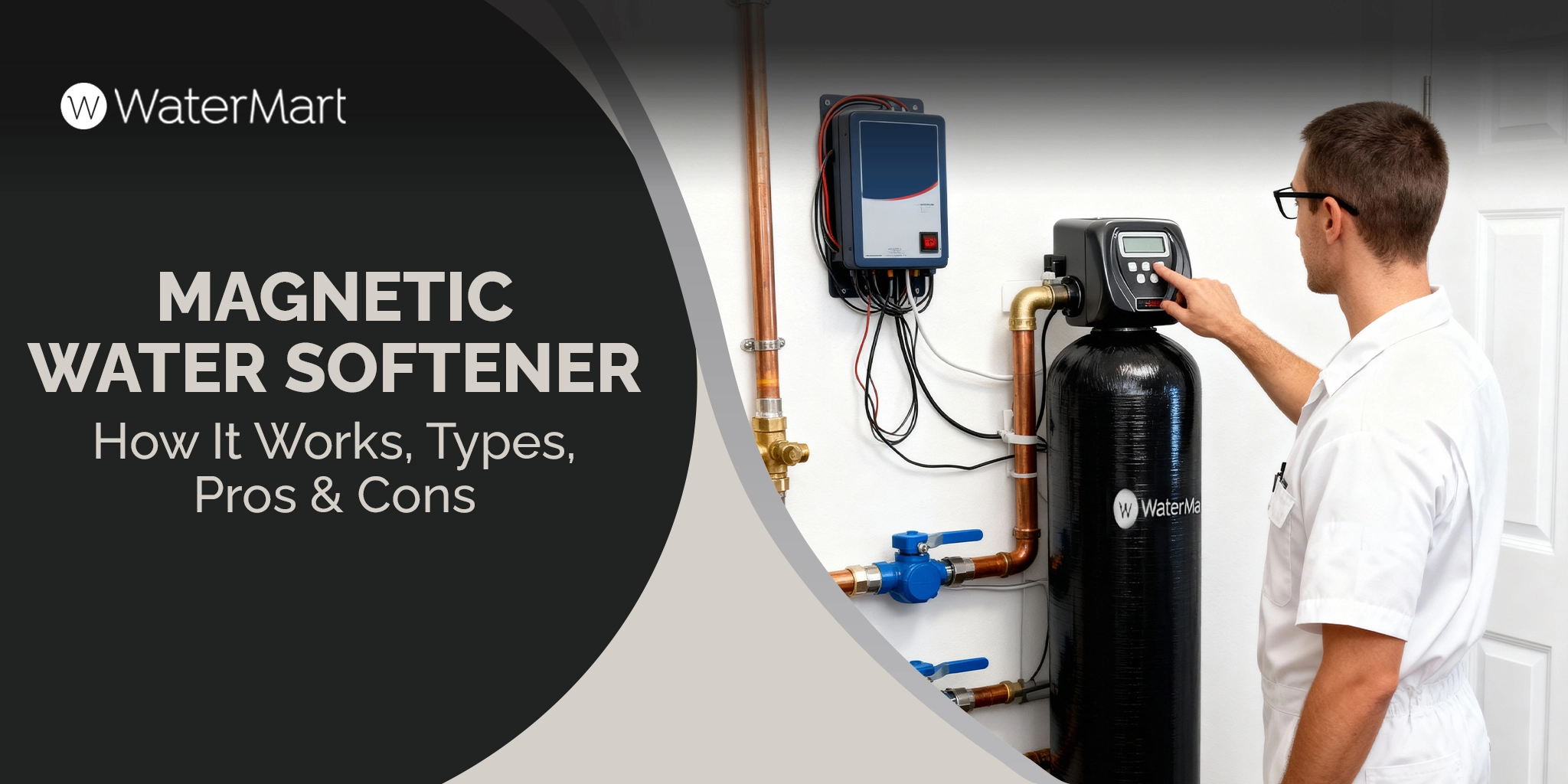
Homeowners who want to deal with hard water using a salt-free option prefer magnetic water softeners. These devices are fitted onto your main water line, where they work to condition water as it flows through using magnetic fields. The magnetic field doesn’t remove calcium and magnesium, but only changes how these elements act while staying in water. These systems are classed as water conditioners rather than traditional softeners because their goal is to reduce scale sticking to pipes, fixtures, and appliances.
How Does a Magnetic Water Softener Work?
When you install or clip-on a magnetic unit on your main water line, incoming hard water is conditioned as calcium and magnesium get descaled before reaching taps and appliances. The magnetic water softener’s working principle activates as hard water flows.
It creates a controlled magnetic field for water treatment that polarizes calcium and magnesium particles. Calcium changes into microcrystals like aragonite that stay suspended instead of forming hard scales. These aligned particles prevent clumping and scale formation.
While your water stays chemically hard, the magnetic field keeps minerals suspended as microcrystals to reduce scale, improve soap performance, limit spotting, and protect plumbing. It’s a physical, temporary water conditioning treatment rather than a water softening treatment.
Types of Magnetic Water Softeners
If you want a temporary way to reduce hard water effects without salt, you can pick the best combination (size and type) for your household’s needs and water usage. Magnetic water softeners come in two technologies and three model sizes:
Permanent Magnet Water Softeners
Permanent magnets generate a constant magnetic field around your house’s pipelines. These devices need no electricity, are easy to install, and continuously change mineral behaviour. They work quietly and effectively for small to medium households seeking low-maintenance water conditioning.
Electromagnetic Water Softeners
If you live in an area with high water hardness, install electromagnetic coils directly onto your main water line pipe. They use electricity to generate a strong and adjustable magnetic field. These systems are better at handling stronger mineral concentrations compared to static magnets.
Inline Magnetic Water Softeners
Inline units fit under sinks or can be attached to dishwashers and washing machines. They treat water only at the point of use, reduce limescale locally, and cost less than whole-house options. This type works best if you need conditioned soft water in specific areas.
Whole-House Magnetic Water Softeners
When you want to treat hard water throughout your home, connect whole-house magnetic systems to the main waterline. They reduce scale in pipes, fixtures, and appliances throughout your home. They require a higher upfront investment, but you get consistent water conditioning treatment.
Portable and Faucet-Level Magnetic Devices
If you need installation ease and flexibility, you can attach portable units to faucets or hoses. They treat small volumes of water for drinking, cooking, or watering plants. Their smaller magnets make them less effective for long-term scale prevention.
Installation of Magnetic Water Softeners
You can install a magnetic water softener yourself or hire a professional (though it’s not needed). The process slightly differs for permanent magnets or electromagnetic coils, but is straightforward for most households:
DIY Step-by-Step Installation Process
Follow these steps to install your magnetic conditioner:
- Turn Off Water: Turn off the water flow for safety and proper positioning.
- Choose Installation Location: Select a straight section of your main waterline before it splits to appliances. This ensures all water entering your home is treated.
- Prepare the Pipe: Clean the pipe thoroughly with a cloth. Remove dirt, grease, or corrosion so the device sits and works effectively.
- Place or Wrap the Unit: For permanent magnets, place them on either side of the pipe and secure them with straps. For electromagnetic coils, wrap them completely and attach firmly.
- Connect Power if Needed: Electromagnetic units require a nearby electrical outlet and may have adjustable settings. Permanent magnets start working immediately without electricity.
- Test the System: Turn the water back on, check for leaks, and run faucets or appliances. Your water conditioner will now begin reducing scale buildup.
Inline vs Clamp-On Installation
You can install inline units beneath sinks or behind machines, but they may require cutting a pipe and fittings. Clamp-on models attach externally without plumbing changes. Choose inline if you want localized treatment, clamp-on for quick whole-house or appliance-friendly solutions.
Installation for Irrigation and Outdoor Systems
If you want to reduce scale in irrigation, strap the device onto the main outdoor line after the pump or water meter. No electrical connections or plumbing modifications are needed. The conditioning effect usually appears within 60-90 days. This is a practical solution for watering systems, sprinklers, or outdoor taps without altering household water lines.
Common Installation Mistakes to Avoid
Although many people can install a amgnetic water softener on their own, you have to avoid some mistakes for proper installation:
- Placing magnets near couplings, water meters, or junctions where the field won’t affect water properly.
- Securing devices loosely so magnets or coils slip, reducing performance.
- Expecting immediate results, as scale reduction can take several weeks.
- Ignoring pipe material compatibility, some magnets don’t adhere well to iron or galvanized pipes.
- Choosing a unit without a proper flow rate or magnetic strength for your household water usage.
Debunking Myths About Magnetic Water Softeners
You’ve probably heard claims about hard water magnetic treatment solving scale, improving soap, or even removing contaminants. Let’s talk honestly about what these devices can and cannot do:
Myth 1: Magnetic Devices Change Water’s Molecular Structure
If someone tells you that magnets restructure your water molecules, they are wrong. Magnetic devices only influence mineral behavior temporarily. They do not chemically remove hardness minerals or fluoride.
Myth 2: Magnetic Systems Prevent Scale Buildup
Some people expect a magnetic device to eliminate scale; that’s a myth. Scientific studies, including tests by the US Army Corps of Engineers, found no evidence supporting that it removes calcium or magnesium ions. Some short-term effects may occur because minerals remain suspended briefly, but this does not prevent long-term buildup.
Myth 3: Magnetic Devices Remove Fluoride and Contaminants
If you are concerned about fluoride, chlorine, or other impurities, magnetic devices cannot help. They have no filtration media to remove these substances. For actual contaminant removal, you need a multi-stage approach, like sediment pre-filters, activated carbon, fluoride-specific media, and point-of-use reverse osmosis systems.
Myth 4: They Are a Cost-Effective Alternative
Many people think they are saving money while using magnetic water, but they are getting minimal benefits from the prices. These units have a lower initial cost, but they rarely reduce scale or improve water quality. True cost-effective solutions are systems that deliver measurable results.
Comparing Magnetic Water Softeners to Salt-Based Water Softeners
Now that you know the advertised claims of magnetic water conditioners, you might be thinking, what works? Salt-based water softeners are the solution. Ion-exchange softeners actually remove hardness minerals, while magnetic units only temporarily influence them.
| Aspect | Magnetic Water Softener | Salt-Based Water Softener |
| Working Principle | Magnetic field reduces scale formation | Ion exchange replaces hardness minerals with sodium |
| Cost | $200-$600, lower upfront | $400-$3,000, higher upfront |
| Effectiveness | Alters minerals temporarily, inconsistent results | Proven, removes up to 99% of hardness minerals, |
| Maintenance | Minimal, occasional cleaning only | Monthly salt refill, brine tank cleaning |
| Environmental Impact | No salt or chemicals, eco-friendly | Salt discharge can harm waterways |
| Ease of Installation | DIY-friendly, clip or wrap on the pipe | Requires professionals, maintenance, and plumbing access |
| Health Concerns | No added sodium | Adds sodium to water, may concern heart patients |
| Appliance Compatibility | Works with most household appliances | Check older appliances for compatibility |
Pros & Cons of Magnetic Water Softeners
Here are the key pros and cons to weigh if you are considering a magnetic water softener:
Pros
Magnetic water conditioners have some clear benefits:
- Low Maintenance: Once you clip a magnetic water conditioner onto your pipes, it just works. No refills or regular upkeep.
- Environmentally Friendly: Your water stays natural, and local waterways aren’t affected by the brine solution.
- Cost-Effective: You pay less upfront than a traditional softener and won’t have to buy salt or chemicals.
- Easy Installation: Most units just attach to your pipes. No cutting, no plumber needed.
- Chemical-Free: Your water stays natural because magnetic water conditioners do not alter the natural mineral content.
- Reduced Scaling Buildup: You might see fewer limescale spots on taps and appliances, which makes cleaning easier.
Cons
Magnetic water conditioners also have limitations that you should understand before depending on them for your home’s hard water issues.
- No Removal of Minerals: Calcium and magnesium remain, so you don’t get fully soft water.
- Variable Effectiveness: Results depend on your water hardness, flow rate, and the specific device you choose.
- Lack of Scientific Evidence: Research shows mixed results for limescale prevention.
- Not Suitable for All Water Types: If your home has very hard water or standing water heaters, scaling will still occur.
- No Immediate Results: Soap and spotting won’t change right away.
- Uncertain Long-Term Durability: Magnets can weaken over time, letting scale return on your pipes.
Key Recommendations for Homeowners
Based on the complete analysis, magnetic water softeners are appealing, but they don’t truly soften your water or protect your appliances over time. The traditional salt basd water softeners offer long-term benefits as compared to magnetic water softenrs.
They are chemical-free & may provide some benefit in Vancouver, where water hardness ranges from 7.9 to 11.8 mg/L. But in hard-water cities like Calgary or Toronto, with 100-120 ppm (6-7 GPG), a salt-based or ion-exchange system is the way to go. You’ll see consistent scale reduction, longer appliance life, and genuinely softer water. Magnetic units might help a little, but for lasting impact, stick with proven solutions.
FAQs About Magnetic Water Softeners
Magnetic water softeners do not actually remove hardness minerals. They just slightly alter mineral behavior, but results are inconsistent, and true softening requires a salt-based system.
They can reduce some scaling in moderate water hardness, but in very hard water, traditional softeners remain far more reliable.
Magnetic units need very little upkeep. You mainly check that magnets or coils stay secure, clean off debris, and occasionally monitor your water quality.
Yes, many models are DIY-friendly.
Magnets do not reliably stop limescale. Any effect is temporary and inconsistent, especially in heated or stagnant water.
No, minerals remain in the water. Magnetic systems only alter mineral behavior slightly, so calcium and magnesium are still present for taste and health benefits.