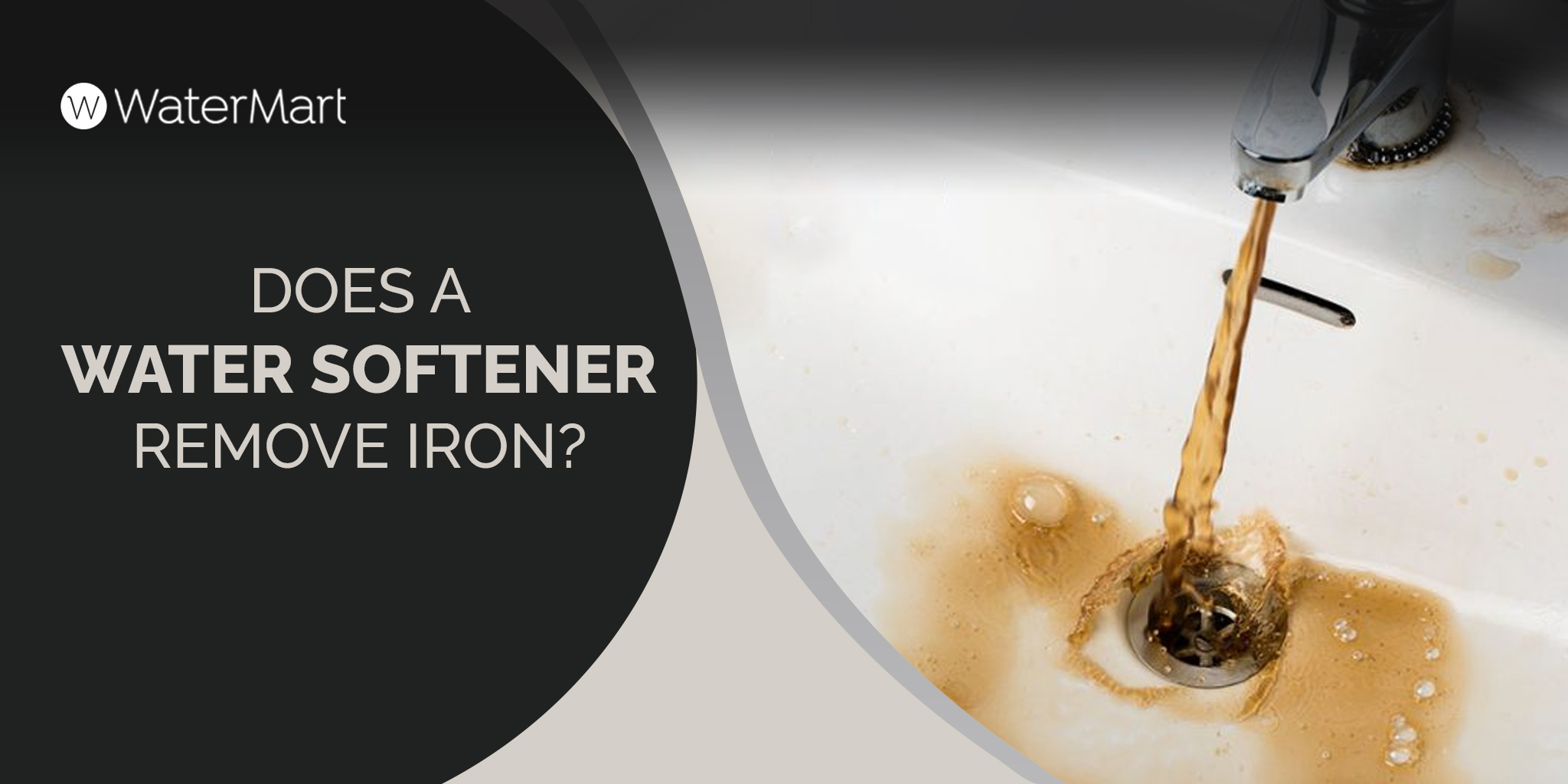
Does a Water Softener Remove Iron? Here’s the Truth
If you’ve noticed rust-colored stains around your sink drains, a metallic tang in your morning coffee, or an odd smell coming from the tap, it’s the iron in your water. And if you already have a water softener installed, you might be wondering: shouldn’t it be handling this? The short answer is: only partly, and in many cases, not enough.
Many homeowners begin to question whether their water softener is actually equipped to handle iron. Even if it has been giving you the right results, the house water may change chemically, especially if it is coming from a well or another municipal source. That’s why knowing the types of iron in your water, its impact on health, and ways of removal can help you decide whether you need a dedicated iron filter next to a water softener or not.
Key Takeaways:
A water softner is mainly used to soften the water by removing hard minerals like calcium, magnisium and trace amounts of iron(1-3ppm), mangnese and other hard metals through ion exchange technique. If your main concern is iron removal for higher iron concentrations(Above 3ppm), a dedicated iron filter along with a water softner can give you best results.
How Does Iron Get in Your Water?
Iron is one of the most abundant elements on Earth, making up roughly 5% of the Earth’s crust. It naturally dissolves into groundwater as rainfall seeps through soil and rock, which is why homeowners with private wells are far more likely to encounter it. The troubling part is estimating how much iron is too much. And the answer is, even a small amount less than 1 mg impacts the quality of water. At concentrations as low as 0.3 mg/L, iron begins to discolor water, and the problems only escalate from there.
Beyond the obvious aesthetic issues, iron in your water can quietly damage your home’s plumbing. It leaves behind stubborn rust stains on laundry, toilets, and fixtures. It alters the taste of everything from your drinking water to your cooking. And over time, it can foul up appliances, clog pipes, and shorten the life of your water treatment equipment.
Types Of Iron Found In Water
Iron isn’t a single problem; it comes in three distinct forms, each requiring a different fix. Knowing which type is in your water is the first step toward solving it.
1. Ferrous Iron (Clear-Water Iron)
If your water looks crystal clear at the tap but turns rust-brown and stains everything it touches the moment it hits air, it has ferrous iron. Ferrous iron is fully dissolved, making it invisible and easy to miss until the damage is already done.
2. Ferric Iron (Red-Water Iron)
If your water comes out visibly orange, yellow, or brown from the tap, it contains ferric iron. Ferric iron has already oxidized before reaching your home, essentially making it rust particles suspended in your water supply.
3. Iron Bacteria
Iron bacteria are the most overlooked of the three. If you’ve noticed a thick, reddish slime in your toilet tank or a musty odor from your taps, iron bacteria are likely the cause. They’re living organisms that feed on iron, foul your plumbing, clog the pipes, fixtures, taps, and tanks, and cannot be removed by standard filtration alone. You need a complete chlorination process to reduce this type of iron.
Not sure what type of iron your home’s water contains? Schedule a water quality analysis with Watermart so we can run a complete test of the iron types and levels present in your household water.
| Type | Concentration Range | Removal by Water Softener | Treatment |
| Ferrous Iron | Problematic above 0.3 ppm; commonly up to 10 ppm in well water | Partial, effective only up to 1–3 ppm; damages resin at higher levels | Water softener (low levels); oxidation + dedicated iron filter (higher levels) |
| Ferric Iron | Visible above 0.3 ppm; severe cases exceed 10 ppm | No, particles bypass the resin entirely and start fouling the resin beads | A dedicated iron filter or sediment pre-filter must be installed before the softener |
| Iron Bacteria | Any detectable level is problematic | No, a slimy gunk or biofilm coats and destroys the resin bed | Shock chlorination + continuous disinfection system |
How Does Iron in Water Affect Your Health?
The health effects of iron in water are usually not severe for healthy adults. The EPA’s 0.3 mg/L guideline for iron is a secondary standard; it’s there to address taste, staining, and aesthetic concerns, not direct health risks.
At elevated concentrations, iron can cause gastrointestinal discomfort, nausea, stomach upset, and changes in taste that make your water an unpleasant liquid to drink. Major concerns about higher iron concentrations include homeowners getting orange, brown, or dusty water that stains everything. So the bigger damage iron does to your home, not your body. It causes stained fixtures, dirty laundry, malfunctioning appliances, and reduced water pressure as day-to-day problems.
Can a Water Softener Remove Iron? How It Works
A water softener primarily removes hard minerals from water through ion exchange. While removing calcium and magnesium, a softener can handle small amounts of dissolved ferrous iron (up to 10 mg/L), but it cannot treat higher levels. A water softener is an ion exchanger, not a filter; ferric iron particles easily pass through the resin (because they remain undissolved), leaving it clogged and shortening its lifespan.
- How Water Softeners Handle Ferrous (Clear-Water) Iron?
Water softeners can remove small amounts of ferrous iron present in hard water, as it remains dissolved and can be removed during ion exchange. But primarily, water softeners are not designed for iron removal (especially when ferric oxide levels are high).
- Can Water Softeners Remove Ferric (Red-Water) Iron?
No, ferric oxide is an undissolved form of iron that remains as suspended particles in hard water, clearly visible most of the time. Since ferric iron is already a solid particle, softeners are designed only to remove iron that’s still dissolved in your water.
Those resin beads have no way to capture rust particles; they just pass right through. Moreover, ferric iron can still foul your resin bed even if the softener can’t remove it, reducing the softener’s lifespan.
- How Much Iron Can a Water Softener Actually Remove?
A standard water softener can remove ferrous iron when levels are low, typically between 0.3 and 1.0 ppm. At that range, the softener does this job by default.
But beyond the 1.0 ppm or even 5 mg/L limit, if you use a water softener as the primary source of iron removal, the resin can become coated with iron, lose efficiency, and start needing special cleaners just to keep up. You end up spending more money maintaining a system that still isn’t fully solving the problem.
| Iron Level | Can a Softener Handle It? | Recommended Solution |
| 0-1 ppm | Yes, typically known as the standard range, it can handle small amounts of ferrous iron (clear iron). | If the concentrations are high, use a dedicated iron filter. |
| 1-3 ppm | This range falls in a higher concentration of ferrous iron that a water softener can remove. | Using a dedicated iron filter before a water softener improves the quality of water and efficiency of the softener. |
| 3-5 ppm | Considered as an upper limit, but a softener can remove this concentration of clear water iron or ferrous iron. | Using specialized iron cleaning salts or twin tanks in water softeners can help remove 3-5 ppm from the water. |
| 5+ ppm | No, this limit is beyond the capacity of a water softener, and iron starts coating the resin beads. | Iron-specific filters, such as a manganese greensand filter or an air-injection (oxidation) system, are recommended solutions. |
5 Signs Your Water is Contaminated With Iron
Iron contamination in water can’t remain unnoticed. Its smell, staining, and fouling of plumbing or laundry clearly indicate its presence. Here are the clear signs you can see in your house water if it contains iron.
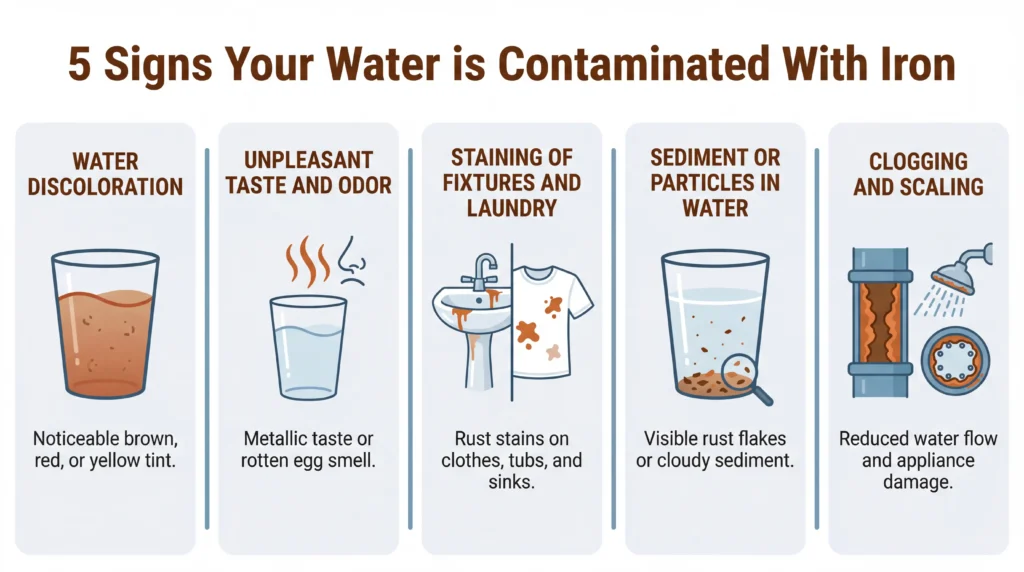
- Water Discoloration: Your water shouldn’t have a color. If it runs orange, yellow, or brown straight from the tap, or starts clear and turns rusty after sitting in the sink, iron is almost certainly the cause. If your water appears clear but leaves stains after running, you’re likely dealing with ferrous iron. If it’s reddish right out of the tap, it’s probably ferric iron
- Unpleasant Taste and Odor: High iron concentrations give water a distinct metallic taste and smell, and with larger water uses like showering, it can fill an entire room with that unpleasant odor. Iron can also make tea, coffee, and cooked vegetables turn dark and taste harsh.
- Staining of Fixtures and Laundry: Rust-colored rings around your drains, reddish-brown streaks in your toilet bowl, and unwanted orange stains on your freshly washed laundry are all signs of iron fouling. These stains can be sneaky; water often comes out of the faucet completely clear, leaving stains only over time, and cannot be removed.
- Sediment or Particles in Water: Pour a glass of water and let it sit. If you notice orange or brown particles settling at the bottom, you’re seeing sediment accumulation. Visible particles are a sign that ferric iron is present at levels your plumbing and your body shouldn’t have to deal with.
- Clogging and Scaling: Iron quietly damages your home’s infrastructure, plumbing, and sanitary items. Over time, iron sediment builds up inside pipes, clogging them, restricting water flow, and leading to costly plumbing repairs. Water-using appliances like dishwashers and water heaters are also affected, facing inefficiency and reduced lifespan.
Tips To Help Your Water Softener Handle Iron Better
Your softener’s primary responsibility is not to fight iron alone, but with the right techniques and strategies, you can extend its life and keep it performing at its best.
Use an Iron-Fighting Resin Cleaner:
Regular salt regeneration doesn’t fully remove iron from your resin bed. Resin cleaners like Rescare or citric acid must be used to remove iron buildup from the resin. Don’t treat this as an optional treatment because, untreated, iron accumulates cycle after cycle until the system fails.
Increase Regeneration Frequency
The longer the iron sits on your resin, the harder it is to flush out. A maximum interval of three days between regenerations is a reasonable balance between limiting resin fouling and maintaining overall efficiency.
Install a Sediment Pre-Filter
Think of it as your softener’s first line of defense. Installing a dedicated iron filter upstream of your softener protects your resin investment and maintains consistent softening performance. It catches ferric particles before they ever reach your resin bed.
Monitor Your Water’s pH
Iron removal works best in slightly acidic conditions, when the pH is less than 7. Ferrous iron is more stable at low pH. Once pH rises, ferrous iron rapidly converts to ferric and deposits directly onto the resin beads, making removal difficult.
Upgrade to Fine-Mesh Resin
If your water has moderate iron levels, the type of resin inside your softener matters. Fine-mesh resin offers more surface area for ion exchange and can remove up to 5–10 ppm of iron, significantly outperforming standard resin in iron-heavy water.
Water Softener vs. Iron Filter: Which One Do You Actually Need?
Think of it this way: a water softener and an iron filter are built to solve two different problems. Using the wrong one, or expecting one to do the other’s job, is where most homeowners go wrong.
- If your main problem is hard water with only trace iron levels below 1 ppm, a water softener alone can handle it. It’ll remove impurities like calcium and magnesium while managing that minor iron presence( <1- 3 ppm).
- If you’re dealing with high iron, visible staining, metallic taste, or orange water straight from the tap, a dedicated iron filter is what you need. Iron filters are superior for removing high iron concentrations (>1-3 ppm), while water softeners handle only low levels effectively. Relying on a softener here will foul the resin and cost you more in the long run.
- If you have both hard water and high iron, which is very common in Ontario well water, you need both systems working together. The iron filter must safely remove the iron first so the water softener can do its job without damaging the resin. The order matters: iron filter first, softener second.
If you are not sure which category your water falls into? That’s exactly what a professional water test will tell you, and it’s the only way to know for certain before spending money on equipment. At Watermart, we offer complete water testing, letting you know your water quality and the systems you might need to install.
| Factor | Water Softener | Iron Filter |
| Best For | Hard water + low ferrous iron (0–5 ppm) | Moderate to high iron of all types (5+ ppm) |
| Iron Types | Ferrous only | Ferrous, ferric, and iron bacteria |
| Method | Ion exchange | Oxidation + Filtration |
| Maintenance | Salt refills and resin cleaner | Backwashing and media replacement |
| Also Removes | Calcium, magnesium (hardness) | Manganese, hydrogen sulfide |
| Limitations | Fouls on ferric iron; pH sensitive | Does not soften water |
When Do You Need a Dedicated Iron Water Filter?
A water softener has its limits and cannot remove chlorine, bacteria, viruses, or heavy metals like iron and lead. It’s meant primarily to remove calcium and magnesium. Here’s when it’s time to bring in a dedicated iron filter:
- Iron levels exceed 5 ppm (even with a high-end softener)
Even the best water softeners work well before this point. At these concentrations, a softener isn’t just ineffective; it’s getting damaged with every cycle.
- You have ferric (red-water) iron or iron bacteria
Softeners can’t capture rust particles, and they offer zero protection against iron bacteria. These two problems require purpose-built filtration from the start.
- Your softener resin keeps fouling despite maintenance
If you’re constantly adding resin cleaners and still seeing iron buildup, your softener is forced to do the job it’s not meant to do.
- Orange stains persist after installing a softener
If you get stains on your laundry, even installing a softener clearly shows that iron is present in the water. Staining that doesn’t go away is your system telling you the iron load is beyond what it can handle. Don’t ignore it.
- Your water pH is above 7
If your water pH is above 7, you need a separate iron filter. At higher pH levels, ferrous iron converts to ferric before it even reaches the resin, making softener-based iron removal largely ineffective.
Frequently Asked Questions
Ion exchange works on dissolved ions, not suspended particles. Water softeners remove ferrous iron through ion exchange, but only up to 1–3 ppm. Beyond this limit, the resin bed becomes ineffective for iron removal.
Ferric iron, being already oxidized and insoluble, fully bypasses the ion exchange process, either slipping through the resin or accumulating within it, accelerating fouling and reducing the system’s operational lifespan.
A water softener targets dissolved minerals, whereas iron bacteria are living organisms that stay in water through a different mechanism. Instead of being removed, they coat the resin bed with slimy gunk, silently destroying the system from the inside out. Shock chlorination paired with a continuous disinfection system is the only reliable way to eliminate them for good.
Because you have an excessive amount (above 3 ppm) of iron present in your water, which can’t be removed by a water softener, if water from the tap comes out clear and turns orange later, it’s the presence of ferrous iron, which a softener is not designed to remove at higher levels. If you are already getting reddish or orange water, it is ferric iron, which is insoluble in water and leaves permanent stains on your laundry and dishes.
If the water softener is treating iron-heavy water, it must regenerate right after 3 to 4 days to avoid resin bead fouling or clogging. If the iron content is low, a softener normally regenerates after 10-12 days.
Standard salt pellets regenerate your resin, but they weren’t formulated to fight iron. Specialty rust-removing salts, such as Iron Fighter or Rust Buster, go a step further by incorporating citric acid or sodium bisulfate directly into the pellet formula. These compounds chemically break down iron deposits on the resin beads during each regeneration cycle, actively cleaning the bed rather than simply recharging it. The result is a resin that stays cleaner longer, maintains higher ion exchange capacity, and resists fouling under moderate iron conditions.
The higher the pH, the faster ferrous iron converts to ferric, and in a softener, ferric iron fouls the resin bed rather than getting removed. So instead of cleaner water, you get a damaged system that’s failing at both iron removal and softening simultaneously. If your pH is above 7, a dedicated iron filter, not a softener, is the right filtration system for the job.
Installing an iron filter or a 1-5 micron sediment filter before a water softener is the easiest way to capture the insoluble iron particles from the water before they reach the resin bed and start fouling it. Iron removal at a large scale needs the installation of chemical oxidation systems.
A water softener can handle trace amounts of ferrous iron, but that’s the limit of its capability. For anything beyond low iron levels, it’s the wrong system for iron removal and will cost you more in damage and maintenance than the problem itself.
If you have hard water with low iron, a whole-house water softener alone works. If iron is your primary issue, you need a dedicated iron filter. If you have both, which is quite common in well water across Ontario, Vaughan, Richmond Hill, Thornhill, Pickering, and Oakville, you need both systems working together, in the right order.
Feeling overwhelmed? A professional water test is the only way to know what’s actually in your water before investing in water filter installation. Call Watermart today for a free water test and expert consultation.